There are a lot of legends about Saint George, who is the patron saint of soldiers, as well as the patronal saint for England, Georgian republic, and numerous other places. Today is also the day on which farm fields are blessed, and in the Carpathian Mountain region where our Church has its origins, this is the day when herds are moved into the pastures after a long winter stuck in barns. George is seen as a protector of livestock and domestic animals.
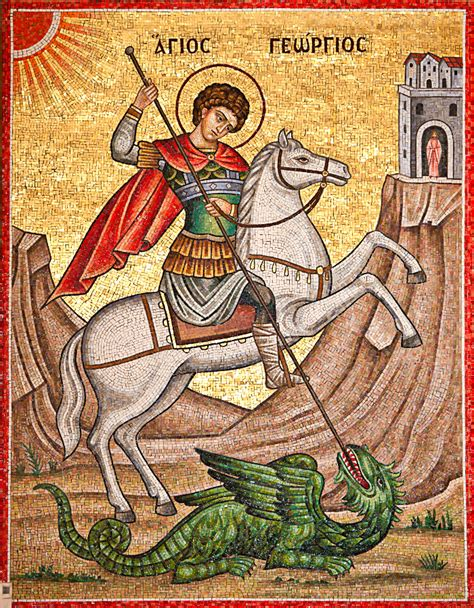
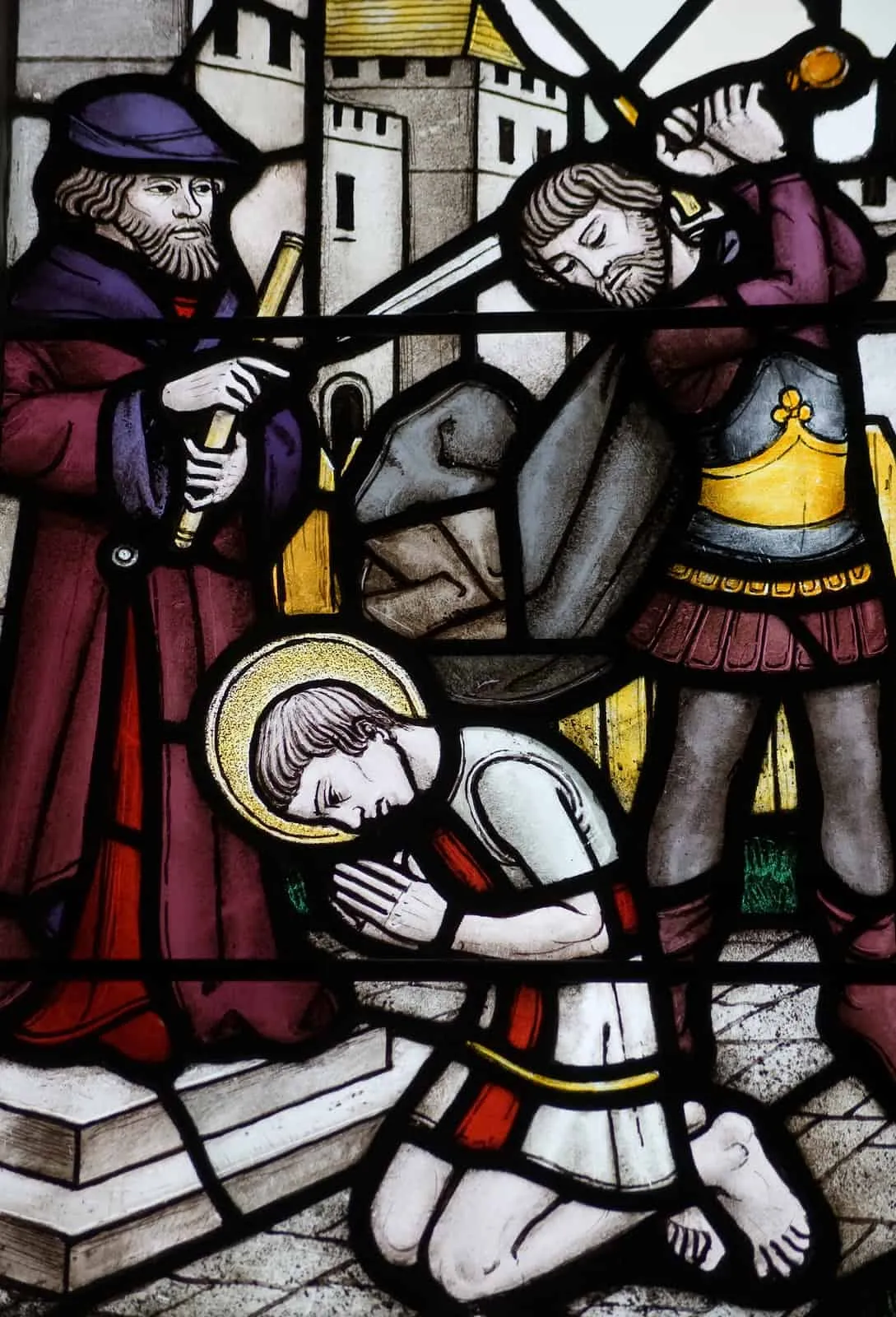
The icons show him as a soldier, and usually on horseback, killing a dragon while a princess looks on from a distance. What we can glean from the legends is that he was a popular officer in the Roman army in the early 4th century. When an edict of Emperor Diocletian ordered the persecution of Christians and that soldiers sacrifice to the gods and the statue of the emperor, George apparently refused. Because he was so well-liked, the judges subjected him to terrible tortures to force him to yield and to frighten the Christian troops, but he would not give up his faith in Christ and was finally beheaded on April 23, in the year 303.
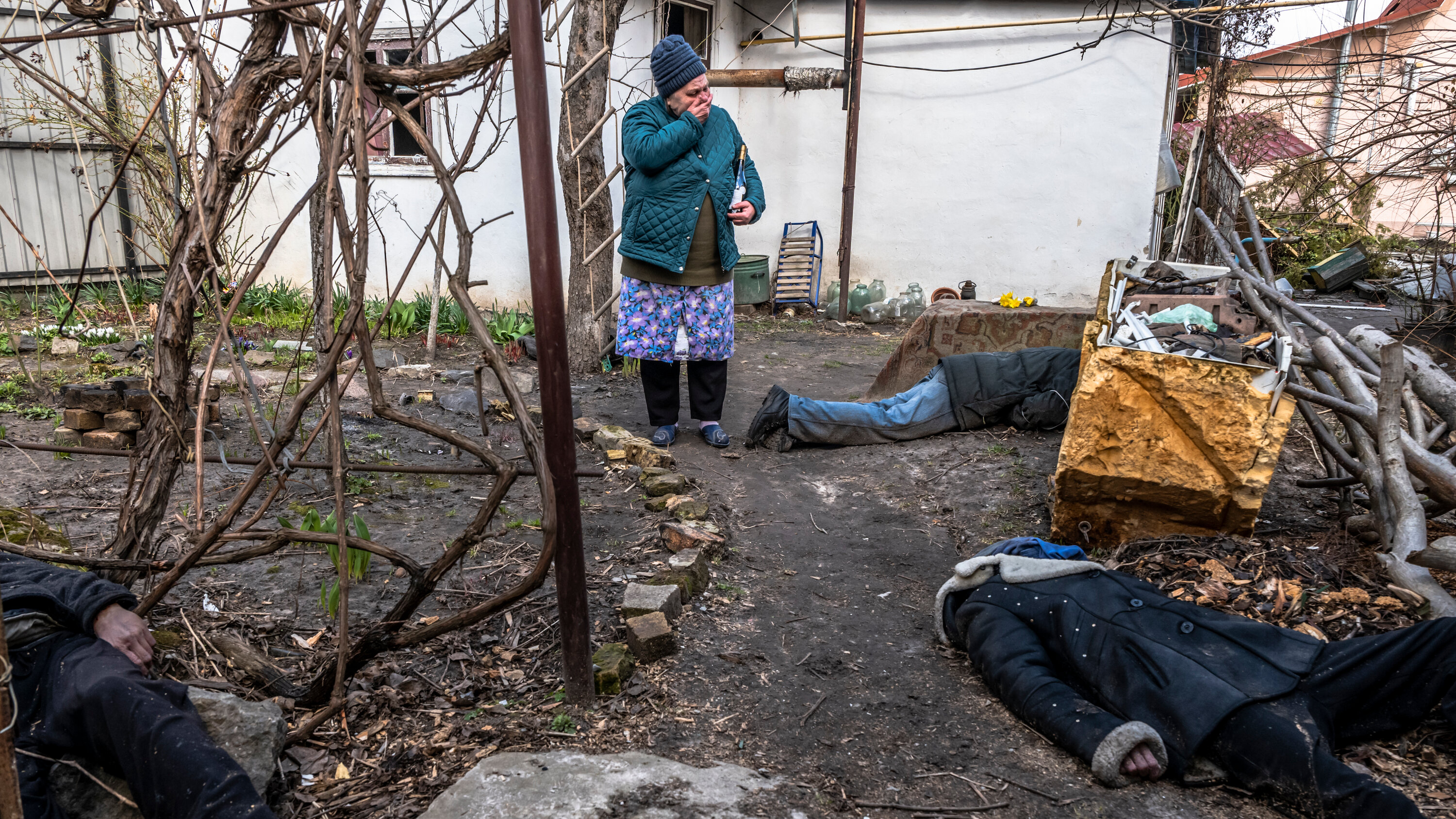
As for the icon, the point is that he battled the devil, symbolized by the dragon, and saved the Christian Church, symbolized by the princess whose name is shown as Ecclesia, or Church. The white horse symbolizes God’s grace carrying him to the heroism of martyrdom. The qualities of George have been invoked ever since as a model for officers in the military: to be faithful to God, to treat soldiers well, and to do one’s duty but never to break with one’s well-formed conscience. Therefore, the truly good soldier is supposed to stand firm for what is right according to the moral law. It is tragic and ironic that the Russian soldiers who are blessed by the Russian patriarch of Moscow in the name of St George and other military saints have been accused of such awful atrocities.
So, what does this feast day have to say to us? Those who persecute the Church always think that violence, murder, robbery, and torture will destroy the faith of Christians. But the Church always goes on. Diocletian’s palace is in ruins, but pilgrims still visit the elaborate tomb of Saint George in Israel. When a French priest opened a church in Nagasaki, Japan, in 1865 he was astonished to be greeted by people who had kept the faith since 1683. When the Greek Catholic Church was legalized in the Soviet Union, the secret police assured Gorbachev that there were no more than a few thousand faithful in the Transcarpathian Oblast, but instead 300,000 came forward. There are always laypeople, clergy, and monastics who will refuse to give in to pagans, atheists, Muslims, or whoever is in power and thinks they can either control the Church of Christ or completely obliterate it.
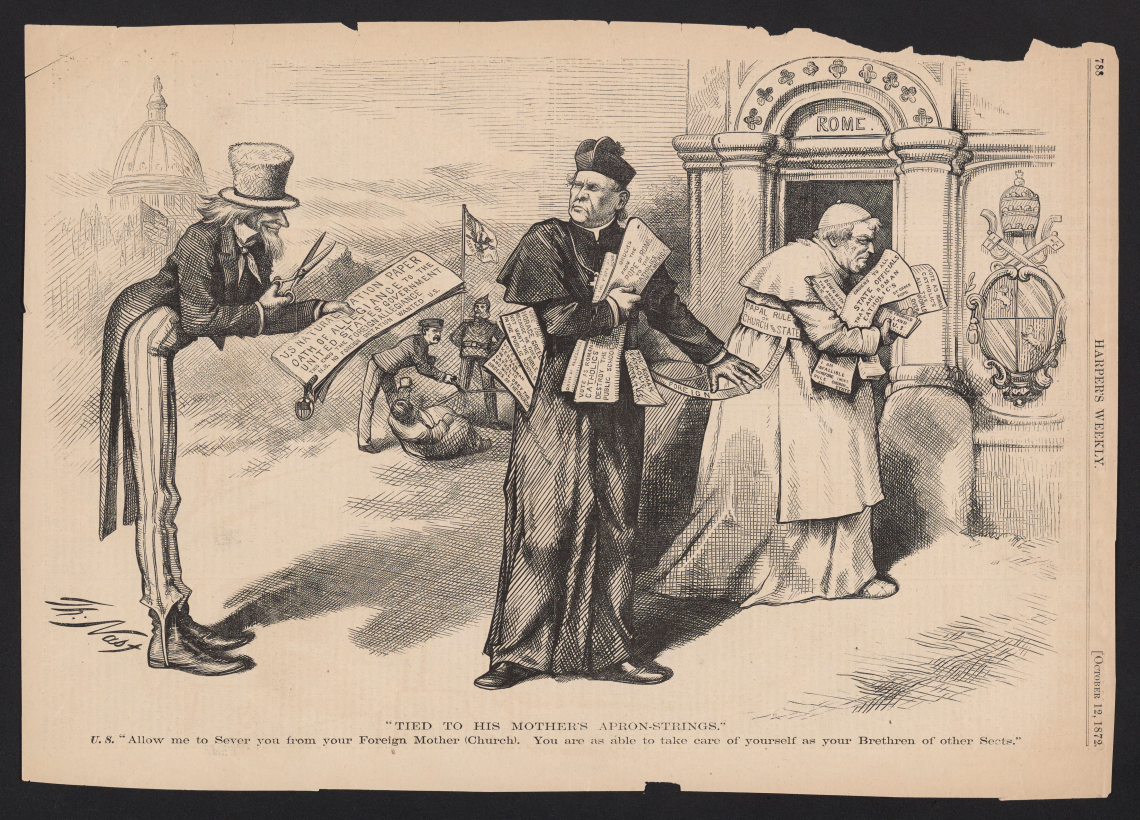
We may not face torture and loss of property, but we do face a culture that has grown more hostile to God, more hostile to Jesus Christ. This country has a long history of being anti-Catholic, going back to the Puritans, as shown in the 1872 cartoon above, and it’s not so long ago that a Protestant Establishment dominated much of the political and economic leadership in America. The more that the Catholic Church proclaims ancient truths, the more hostility we as faithful believers who uphold those truths will encounter from some secular-minded people.
Soldiers in democratic societies are bound to a moral code of conduct, and officers are bound to exercise good leadership that both takes care of their troops, is not morally objectionable, and fulfills the mission. Our code of conduct is found in the Catechism, and we are each called to exercise good leadership as baptized members of the Body of Christ. May St George, and all of the great martyrs, pray for us that we will never forsake Christ and His Church, and that we will fulfill the mission entrusted to us at Baptism: to lead lives that will take us home to heaven, and to bring other souls along with us on the journey to God.
Letter of Saint Paul to the Romans 5: For while we were still weak, at the right time Christ died for the ungodly. 7 Indeed, rarely will anyone die for a righteous person—though perhaps for a good person someone might actually dare to die. 8 But God proves his love for us in that while we still were sinners Christ died for us.
God proves his love for us in that while we still were sinners Christ died for us.
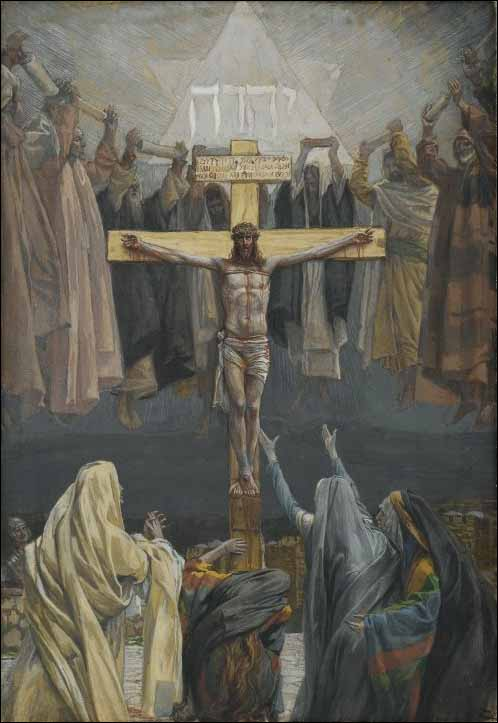
The Catholic Church is born on the Cross. Catholic means universal, and Pilate had the famous inscription “Jesus of Nazareth, King of the Jews” written in the three languages used in Judea and Galilee at the time: Hebrew, Latin, and Greek. There is no division in the Church, which serves all people. The Church is rooted in the sacrifice of Jesus Christ, born from the wounded side of Jesus, in the blood and water which gushed forth from his side when the centurion pierced his side and his heart. That blood is the blood of the Holy Eucharist, that water is the water of the Mystery of Baptism.
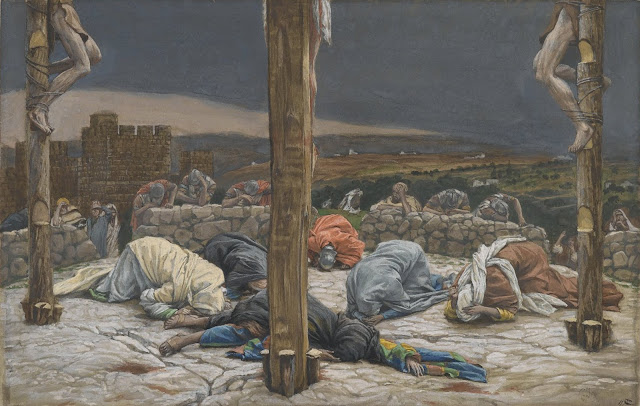
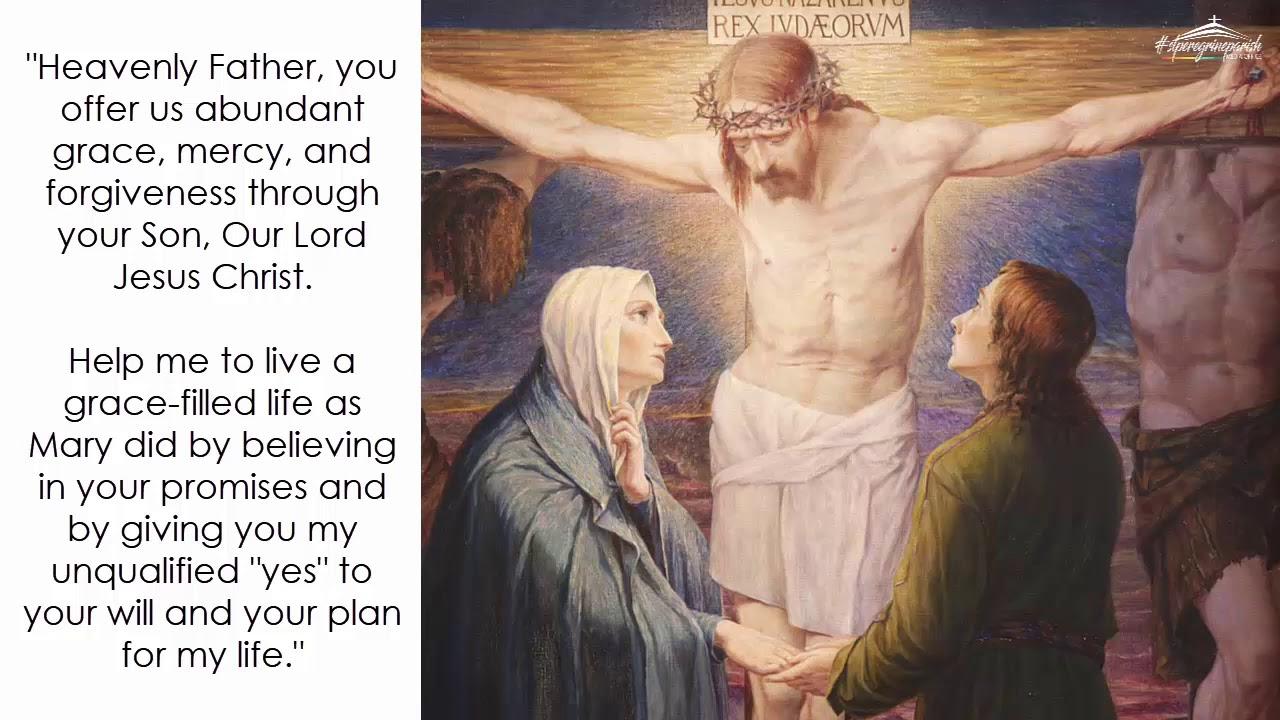
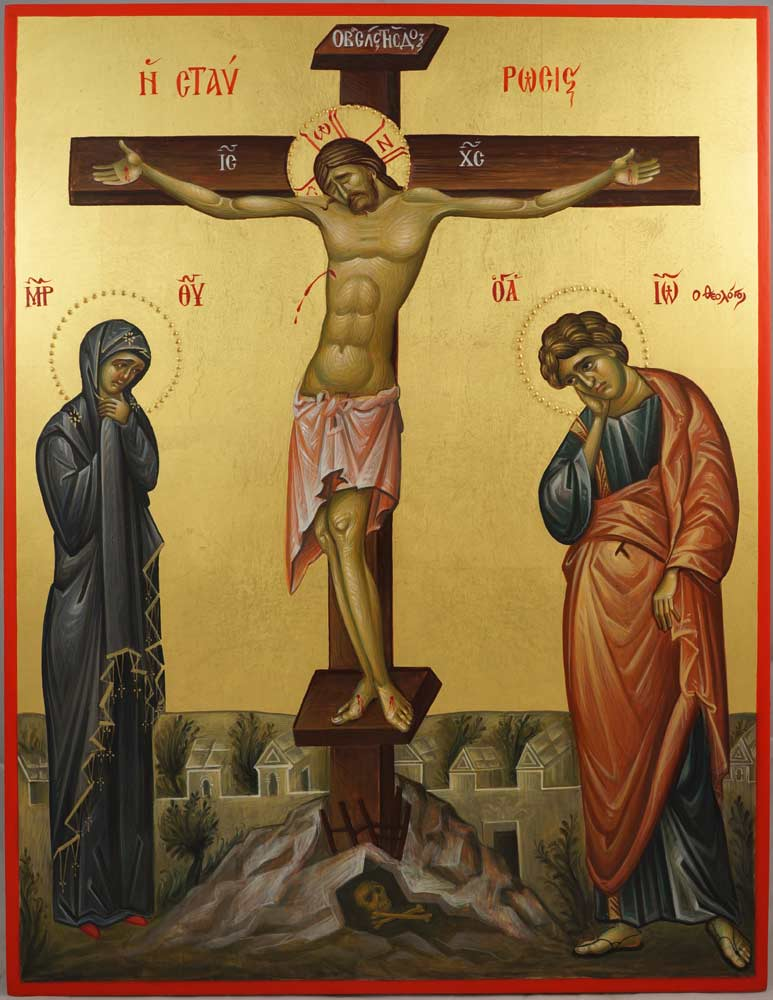
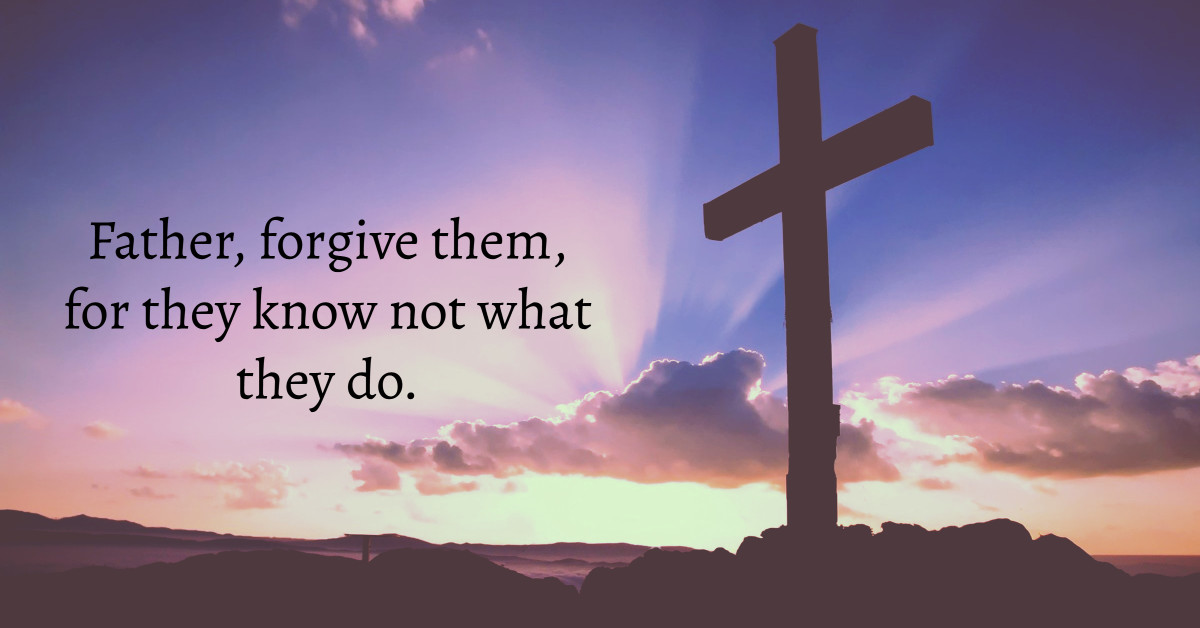
Our Blessed Lady and the teenager John, the Beloved Disciple, stand near the Cross. Mary becomes the Mother of the Church, John becomes the brother of Jesus, in that famous verse of the Last Words, “Behold your mother, behold your son.” The Church is rooted in these two and the holy women standing with them as being founded on their loyalty, their discipleship, their dedication to Jesus even at the worst moment possible. The Good Thief achieves salvation by acknowledging his guilt, by stating the innocence of Jesus from the false charges, and by proclaiming his confidence in the ability of the Lord to save his soul from perdition, and Jesus assures him, “today thou shalt be with me in paradise.” The sun had disappeared at noon, in fulfillment of the writings of the prophets Joel and Amos and Zechariah who predicted darkness and despair at midday, and the whole crowd of Jews and Romans was struck with fear and anxiety, but Jesus never condemned those who put him on the cross that day. Rather he said, “Father, forgive them.”
God proves his love for us in that while we still were sinners Christ died for us.
Jesus does not wait for the Sanhedrin to convert, or for the leaders to apologize to him. He grants forgiveness in a profound act of love and mercy. Christ does not cry out in despair when he says My God, my God, why hast thou forsaken Me? It is rather a cry of triumph, for Psalm 22 which he quoted is filled with predictions of Jesus’ passion, from the terrible dryness of his mouth to the soldiers gambling for his clothing. But that psalm ends with the triumph of the messiah, whose name will be known for generations to come, and here we are 2000 years later, gathered like that little band of disciples at the foot of his cross and proclaiming his passion and death.
The Church is born out of Jesus’ suffering and death. The Church is based on the self-giving of Jesus – when He poured Himself out at the Last Supper in confecting the First Eucharist, that Eucharist we are privileged to make present at each liturgy; when he confronted the spiritual darkness of the world in the Garden of Gethsemane; when he endured false accusations in an illegal trial; when he was beaten and scourged and mocked by 200 angry Roman soldiers; when he carried his cross despite the tremendous loss of blood and being deprived of food or water through the hot streets of Jerusalem packed with pilgrims. He died on the cross as the true paschal lamb, the true redeemer of Israel, the true Son of God, and does so as the ultimate self-emptying act of divine love. Innocent, a miracle-worker, a preacher, who never hurt anyone, dies in great pain.
God proves his love for us in that while we still were sinners Christ died for us.
It is the great paradox of Christianity that we proclaim both a God who willingly ascends the cross for the most shameful and frightening form of execution known at that time, and that this God allows this to happen as an act of love. The Gospel tonight and the Twelve Gospels sung earlier today give us the entire passion of Jesus, from his walking to Gethsemane to his burial. Out of all of the thousands who had benefited from the miraculous feedings, the miracles of healing, who had heard his powerful words in his sermons, we know of only the Virgin Mary, Saint John, Mary’s sister, Mary Magdalene, Salome the mother of John, and Mary of Cleophas. Beyond them are the people of the crowd, those who watched the long painful drama. Who am I when it comes to living my faith, proclaiming our faith, defending our faith? Am I part of the band of faithful disciples, or am I watching on the sidelines? Do I start my day in prayer, or rushing around? Am I the person who curses in busy traffic, or the one who lets the other driver into my lane? Do I open my bible or a scripture app to read the scriptures of the day, or does the bible collect dust? Do I learn about the faith, about the holy trinity, about the saints, or am I ignorant beyond what I was taught for my First Communion?
God proves his love for us in that while we still were sinners Christ died for us.
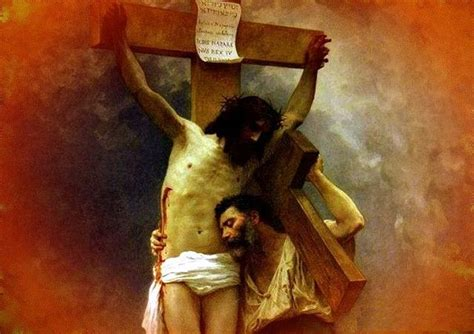
Jesus came into the world out of love – He came from heaven and became incarnate of the Virgin Mary through the Holy Spirit so as to reopen the doors of heaven, closed when humanity turned its back on God’s command and committed original sin. He came to give us not an option, but the true path to living with him forever. Simon of Cyrene came to faith carrying Jesus’ cross, while the bloody Savior staggered from pain. The Good Thief came to faith hanging on a cross on Jesus’ right side, and is so drawn to Christ that he is the only person in the gospels who calls Jesus by His Name only. The women and the young teenaged lad stayed faithful in front of the tragedy when the men who had walked with Christ for three years had fled.
God proves his love for us in that while we still were sinners Christ died for us.
Golgotha was called the Place of the Skull. Not because it looked like a skull, but because it was said that Adam’s skull rested inside that hill outside of Jerusalem. The New Adam was crucified so as to redeem the Old Adam; on Holy Saturday, Saint Peter wrote, Jesus descended to preach to the souls of the righteous imprisoned in Sheol for thousands of years, and to deliver them into heaven and so to the true home of the human race. The Blood of the Lord trickled down the cross into the ground, announcing to Adam that redemption was finally at hand.
Our redemption is achieved on this cross. There is no salvation without the cross, there is no Easter Sunday without Good Friday. We are invited to accept this salvation, we are asked to realize fully what divine love is, how enormous it is, how generous it is, how gracious and merciful that love is on the cross. God proves his love for us in that while we still were sinners Christ died for us.
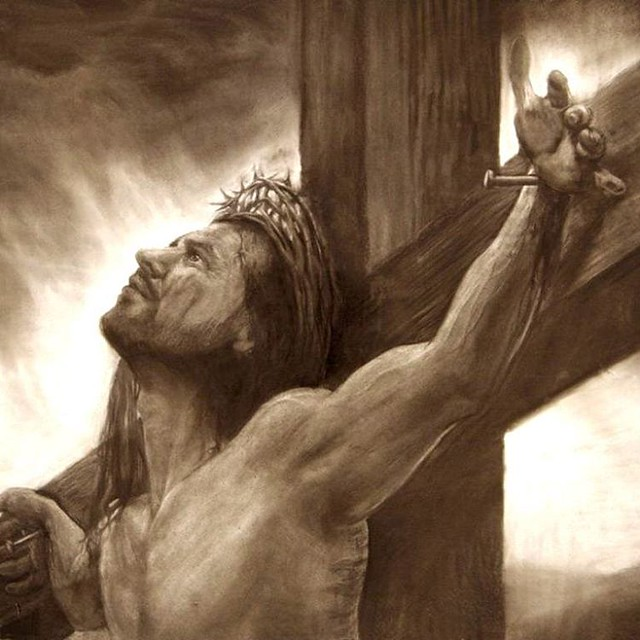
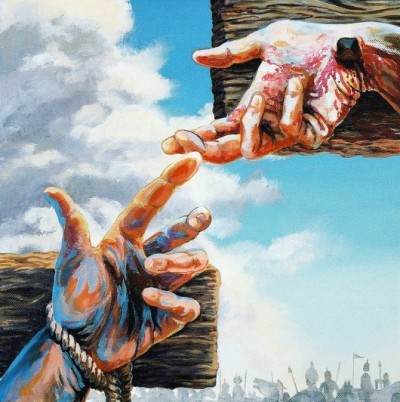
We are saved by the life, death, and resurrection of the Lord Jesus. The invitation is extended to us by the pierced hands of Jesus on the cross, by those arms stretched out to embrace the entire world. Do I accept this invitation? How am I living my faith out? Perhaps one-third of American Catholics attend Mass every month. Two-thirds of Mormons go every week, 44% of Protestants do, 38% of Muslims go to mosque weekly. But we, who believe correctly that the Crucified and Risen Lord gives us His Body and Blood, have two-thirds sitting at home routinely. The darkness that Jesus faced at Gethsemane, when his blood became like drops of blood falling down upon the ground, has engulfed our country. It is up to you, the laypeople who are so good about coming to church, you who faithfully worship so regularly, to bring souls into the embrace of those arms stretched out on the cross. It is up to you to learn your faith well so that you can truly invite souls to the Lord. It is up to you, above all, to believe that God proved his love for you, for us, for the entire human race, while we were still sinners, by the saving death of Jesus on the cross. God proves his love for us in that while we still were sinners Christ died for us.
So great is Christ’s love for us, that he would willingly endure the scourging, the beating, the mockery, the nailing to the rough wood of the cross, the piercing of his sacred heart, over and over again were it necessary so as to save each soul. But it is not necessary, for God has proven his great love for us in that one crucifixion, that one death, that one burial, that was done for us. People will take turns tonight to imitate Mary Magdalene and Mary of Clopas who stayed sitting in front of the tomb. When we kiss the wounds of Jesus on the holy shroud, when we sit in darkness, when we sit and pray, let us accept and own the fact that God loves each of us profoundly and deeply. Let us give thanks for this sacrifice. Let us resolve to be true missionaries of Jesus Christ in the world. Let us resolve to pray and do penance for the salvation of the world, the rebuilding of the Church, the conversion of sinners, and for the triumph of the Prince of Peace in the hearts of the world. God proves his love for us in that while we still were sinners Christ died for us. Let us live, pray, and witness to that accordingly.
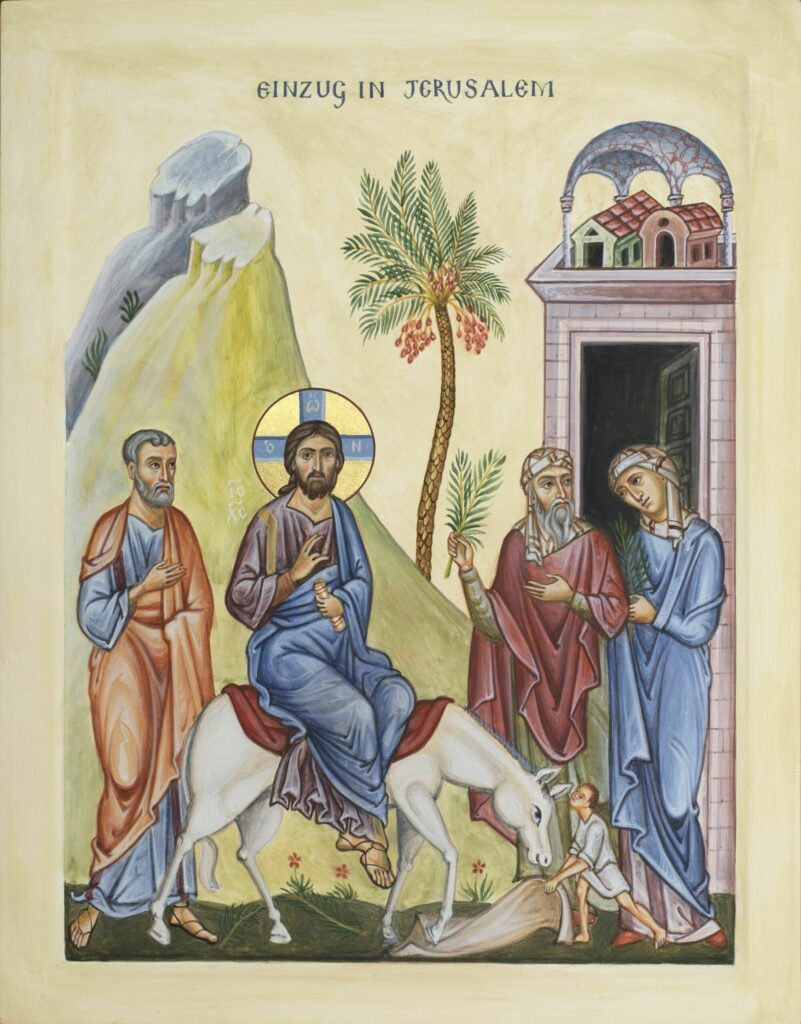
Rejoice greatly, O daughter Zion! Shout aloud, O daughter Jerusalem! Behold, your king comes to you; triumphant and victorious is he, humble and riding on a donkey, on a colt, the foal of a donkey. Zechariah chapter 9, verse 9
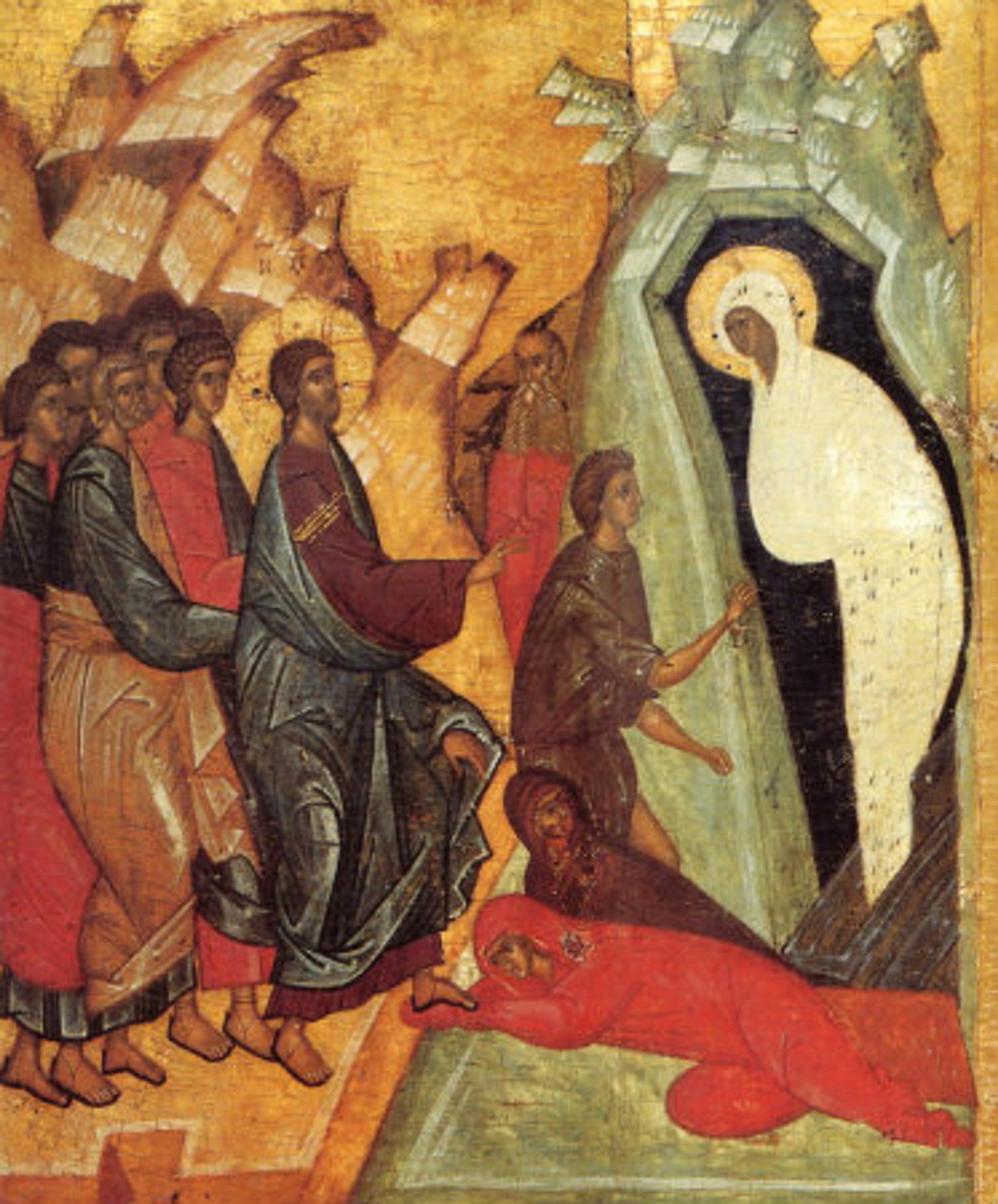
By the time Jesus enters the holy city, most people knew about the resurrection of Lazarus after four days in the grave. Not even the great prophet Elijah was able to achieve that. But even with that stupendous miracle, that challenged the teaching of the Sadducee party so much that they decide not to convert to faith in Jesus as the messiah, but rather to have him killed. That is what we are entering into this week. The Sadducees would rather hold to their preconceived notions that there is no afterlife, no resurrection of the dead, and only preservation of the Jewish nation as the reason for existence than believe that Jesus has come to bring about the fulfillment of the Kingdom of God. Caiaphas and Ananias were so corrupt, that they ignored the power of that miracle and all of the miracles, and instead worked at destroying him and the growing movement around him.
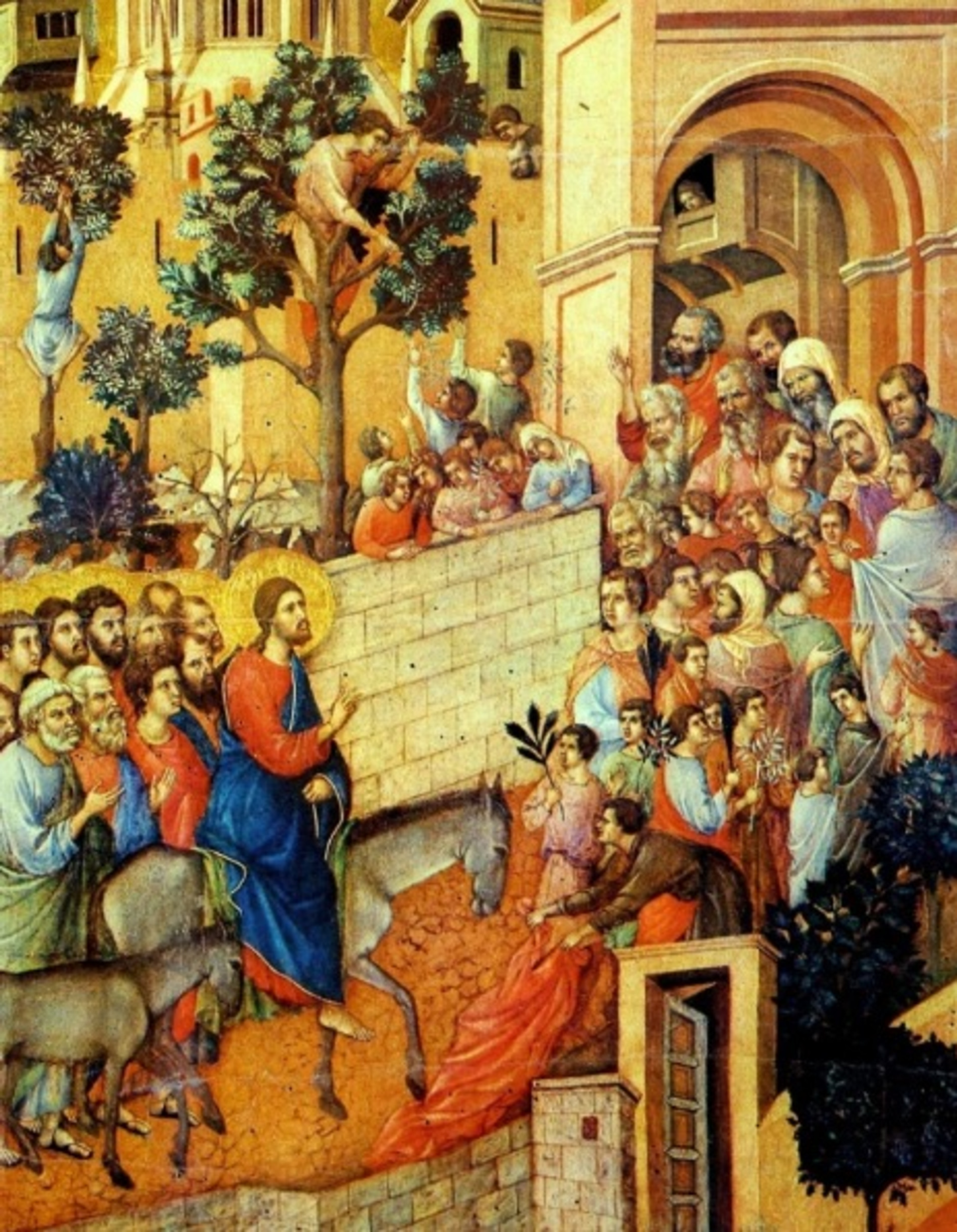
In ancient times, when a king rode into a city, it was usually with a show of power and wealth. Christ is both the rightful king of Israel and the gentle king. Jesus comes to greet his subjects, not with pomp and circumstance, but with all humility and meekness. At the very least, one would expect Jesus to ride a horse. But instead of coming on a mighty war horse, he rides a lowly beast of burden. He is riding a donkey, of all creatures—and a borrowed donkey, at that! He came in on a colt that has never been ridden by anyone. Try to get on any donkey or horse that has never been ridden before, and the animal will buck and toss off the person, because it is not used to the feeling of weight on its back. Instead, it is clear that our Lord simply gets on the animal and rides into the city, because like the ox and donkey in chapter 1 of Isaiah, that donkey recognizes its Master, its Creator, and simply goes along gently. Both the Lord and the donkey are gentle, and Jesus conquers with gentleness. The people acclaim him, the children praise him, and Jesus warns that even the stones of the hillside would cry out in triumph if the people had not done so.
Western societies of today worship celebrities and politicians and athletes. We want glitz, we want bling, we want to see someone set a new record. Just like people in the ancient world, we want to see glamour and we want to see power. Politicians who try to give reasonable answers to complicated questions are routinely ignored by our media in favor of those who give angry, often ignorant sound-bites. What would our media make of a gentle preacher, a teacher who refused to condemn sinners, a rabbi who broke the rules but did so out of compassion and love? Jesus created a family based on those who acted upon His word, a family based on discipleship. The prophet Zechariah used the word daughter, reminding the Jews that God saw the Chosen People primarily and first of all as His children, not as an aggressive power.
Christ gave care of the Blessed Virgin on Good Friday not to his aunt who was standing with her, but to the teenager John, who had no possessions of his own but the love he felt for the Lord. The family of Christ, the family of Christianity, the Church itself, is meant to be a community rooted in loving the gentle teacher who would not condemn sinners, but who did condemn injustice and cruelty. The family of the Church is supposed to be rooted in following the Lord Jesus Christ and proclaiming His Good News to a broken world that is racked by violence and anger and hatred.
We rightly condemn Vladimir Putin and his atrocities, and the Russian patriarch who has simply become the altar boy of the Russian dictator. But are we equally appalled at those around us who claim to worship Jesus’ Name, but condemn people for being the wrong ethnic group, the wrong religion, the wrong political party, sometimes even supporters of the wrong team, and use the Holy Name of Christ as a curse word?
This week this gentlest of kings, who children flocked to and an unridden colt accepted instantly, is going to endure abandonment, torture, great suffering and pain, and do so all because of his great love for each of us. He is most certainly not a weak man – he spent three years preaching and performing miracles despite pressure from the leadership in the Temple to stop. He interacted with foreigners as easily as he did with Jews. And in His passion, he went from the Last Supper all the way to the Cross, shedding tremendous amounts of blood and suffering at the hands of violent men, with neither food nor drink to strengthen him. His kingdom is one of peace, and sometimes it takes more courage to proclaim peace than to declare war. The prophet Zechariah says in verse 10 that the Messiah “will proclaim peace to the nations. His rule will extend from sea to sea and from the River to the ends of the earth” and proclaim the good news to the Gentiles. Jesus in His great power, in His great love, in His great gentleness, brings truth and the victory of peace to all nations. He is powerful enough to save the entire human race, and loving enough to intervene on behalf of every single individual, to year for the redemption of all of His creation.
If we are saved by such a gentle king, then we should serve him with all gentleness. Gentleness is one of the marks of the Christian, the fruit of God’s Holy Spirit. Holy Week leads us to Easter Sunday, and Easter Sunday opens the door to prepare ourselves for the Descent of the Holy Spirit on Pentecost. We as Christian people, men and women and children, people of all ages, are called to transform a world that is currently dominated by violence, anger, nasty conversations, terrible wars into the world desired by God Himself.
Saint Paul proclaimed in his letter to the Philippians: “Let your gentleness be evident to all” (4:5). Jesus commanded at the Last Supper on Holy Thursday night, Love one another as I have loved you. The Blessed Virgin implored us at Fatima to pray for the conversion of Russia, not its destruction, and for the conversion of sinners, not their damnation. In waving palms and willow branches, let us be more faithful than the apostles were on Holy Thursday, more enthusiastic for Jesus than the crowd was on Good Friday, and more determined than ever to welcome the Resurrection on Pascha with converted hearts.
Matthew / Mark “He cried again with a loud voice/ scream and gave up his spirit.”
Luke 23: 46 Then Jesus, crying with a loud voice, said, "Father, intothy hands I commit my spirit!" -- and the centurion said: This man was innocent, and the crowd went away, people beating their breasts" (a traditional sign of sorrow and penance).
John 19:30 “Jesus had received the (vinegary) wine, and he said, “It is finished”; and he bowed his head and gave up his spirit.A better translation for this word is this: IT IS FULFILLED./ accomplished/ consummated.
Now – He breathes his last —- what does he breathe out? SPIRIT – the first breathing of the Holy Spirit to the church is this last sigh out of Jesus’ exhausted lungs, to those standing below, to the beloved disciple, to the mother of the Lord, to the small faithful band of disciples.
INTO THY HANDSI commend my spirit shows us that Jesus knows that He was never ever abandoned by God the Father, despite the great loneliness He felt on the Cross earlier. There is a theology of abandonment that is popularly preached today in Protestant churches and among many Roman Catholics: that Jesus looks over the holy city, under the darkened sky, with the wind howling around him, and that he despaired.That is NOT the tradition of the ancient Church. Rather, that Jesus spoke the opening words of the messianic psalm 22, a psalm which indeed lists aspects of the passion itself, and ends with the messiah’s triumph.
Preachers take the opening verse and use it to say Jesus understands us in our abandonment, he felt abandoned on the Cross. No, he was abandoned when Judas kissed him and all in the garden when all fled; when Peter refused to acknowledge Him in the courtyard of the high priest and then Jesus looked right at him, and Peter went out to weep — but not to stand next to Jesus. And after Jesus said that verse from Psalm 22 on the Cross, the earth quaked, rocks split, and the inner curtain of the temple was torn from top to bottom – by the hand of God the Father Who like His Jewish children tears his garments in grief – so did God at the pain of His Son, but the necessary pain which must be fulfilled and so God answered that prayer.
Jesus does not die to appease an angry God nor is he the object of divine anger. He is the recapitulation, the anakephaliosis of the human nature which all share. Thus, in Psalm 22 it is the voice of fallen human nature, but not a cry of despair. With the tearing of the veil, Jesus’ sacrifice is accepted.
And here – Jesus does not feel abandoned whatsoever. He instead says two things – it is finished – into THINE hands – the intimacy with the Father is still present – Now he bows his head – why? Out of exhaustion/ despair/ willing suffocation? NO, watch the motion! He gives of himself to those below, to his mother, St John, the other women, witnesses in the crowd. His head goes in a downward direction: He breathes his last onto them.
John 19 verse 34: “One of the soldiers pierced his side with a spear, and at once/ immediately there poured forth blood and water.”
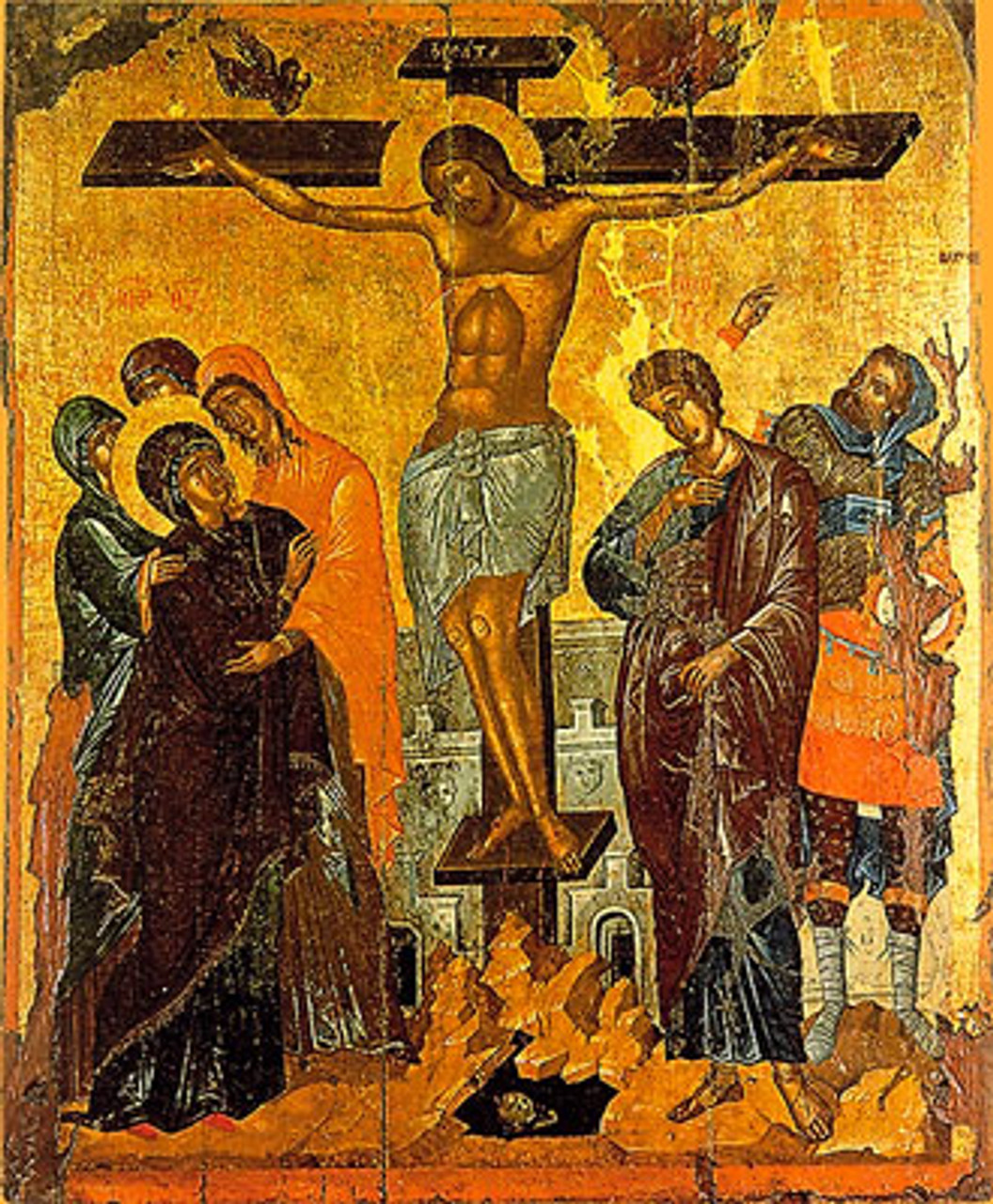
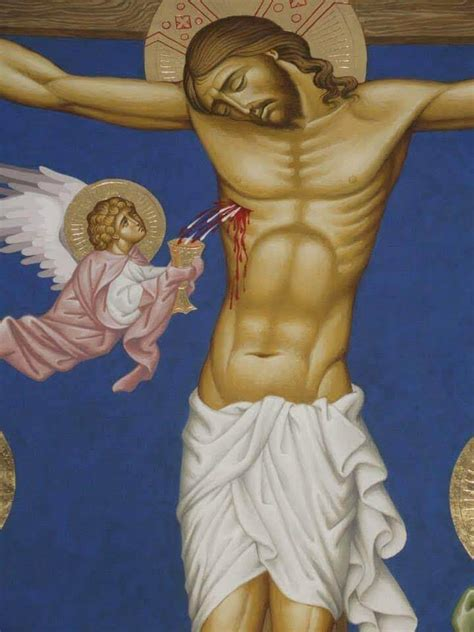
The blood and water: John sees it is a miracle. After all the suffering of Jesus, how could there be anything left in Him? It is not dribbling, it is not serum from the lungs. The spear tore through the Body of Jesus, and likely pierced the pericardium of the heart, which is filled with water. But this is not about an anatomy lesson. It is about the Son of God giving in death, as foretold by the Prophets, from His wound that the icons always show in the right side, which fulfills Ezekiel’s prophecy and also shows us the brutality of that spear’s piercing through that sacred body to the sacred heart of Christ Himself.
Zechariah 14:8 On that day living water will flow out from Jerusalem
Ezekiel 47:1-2: water is coming forth from under the threshold of the temple eastward, for the front of the temple [is] eastward, and the water is coming down from beneath, from the right side, from the south of the altar.
The water is coming out of Jesus’s right side: He is the new Temple. In the First Letter of John we read: 6This is the one who came by water and blood—Jesus Christ. He did not come by water only, but by water and blood. And it is the Spirit who testifies, because the Spirit is the truth. 7For there are three that testify: 8the Spirit, the water and the blood; and the three are in agreement.
Here, John says that the water and blood gush, pour out. In one of the legends, it says that the centurion Cornelius was blind in one eye but the pouring water hits that eye with force and he is cured. It gushes from that dead sacred body – a sign of fulfillment of running water; the water equals Baptism; blood equals the Eucharist; his breathing of the spirit equals Chrismation / Confirmation – the traditional order of the three sacraments of initiation still preserved in all Eastern Churches and in the rite for adult converts in the Roman Church.
He has brought everything to fulfillment, to completion – and now? Here? Now it is up to each of us, for whom he suffered willingly, out of love that we just are beginning to understand, he has given each soul since the crucifixion life – and we must complete our lives.
He gave everything in the end to the Father – the father now is the mother. Jesus compared God to a mother hen, longing to gather the chicks of doomed Jerusalem under her wings. Now he puts himself into the hands of the Father – gentle loving motherly hands which receive his soul and a loving father who kisses away the tears and soothes the exhaustion of the human Jesus.
So, to the completion of our lives. We must embrace the cross. He was pierced for us. He pours out water and blood for us. He accepted all of this willingly, he entered the passion in full command of himself, and so in his death he is giving life. Jesus is the new human, the original human without sin. His innocent death is sacrificial and therefore saving. Death cannot hold this human nature any longer, thus the resurrection. We are in Adam thru human nature but we are in Christ thru Baptism and thus share in this renewed human nature of Jesus.
When we come to the end of our own lives, may we have the faith and trust to say into the darkness: Father, into thy hands I commend my spirit. And may we remember that Jesus, who suffered all this willingly, suffered it just for me – and so will be close at hand at that moment. Let us live as ones whose souls are loved passionately by God, and let us love others in fulfillment of the one commandment that Jesus gave to his disciples.
Let us give Him love, and not count the cost. Let us love others, and not count the cost. Let us work in the power of the Suffering and Risen Lord, through the working of the Holy Spirit, to transform this broken world into His Kingdom. Let us not flee from our cross, but embrace it, and realize this is the truth: Ave Crux, spes unica! Hail O Cross, only hope!
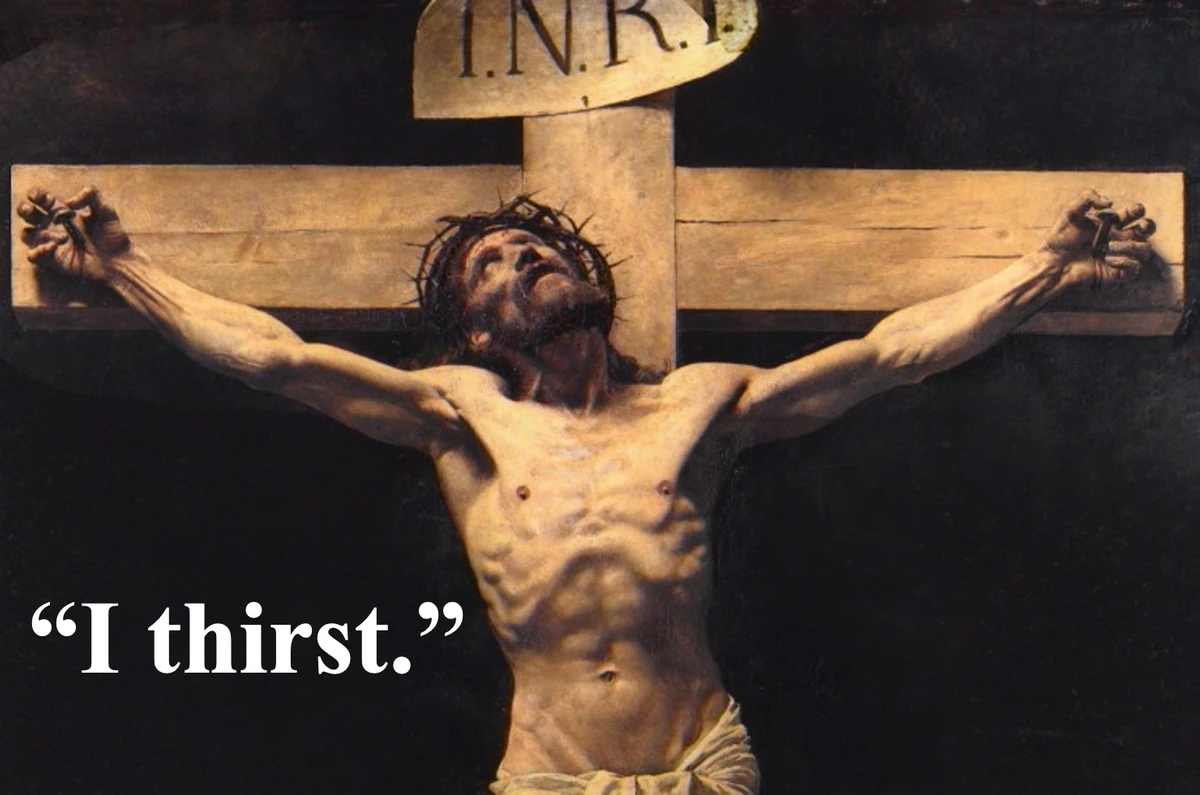
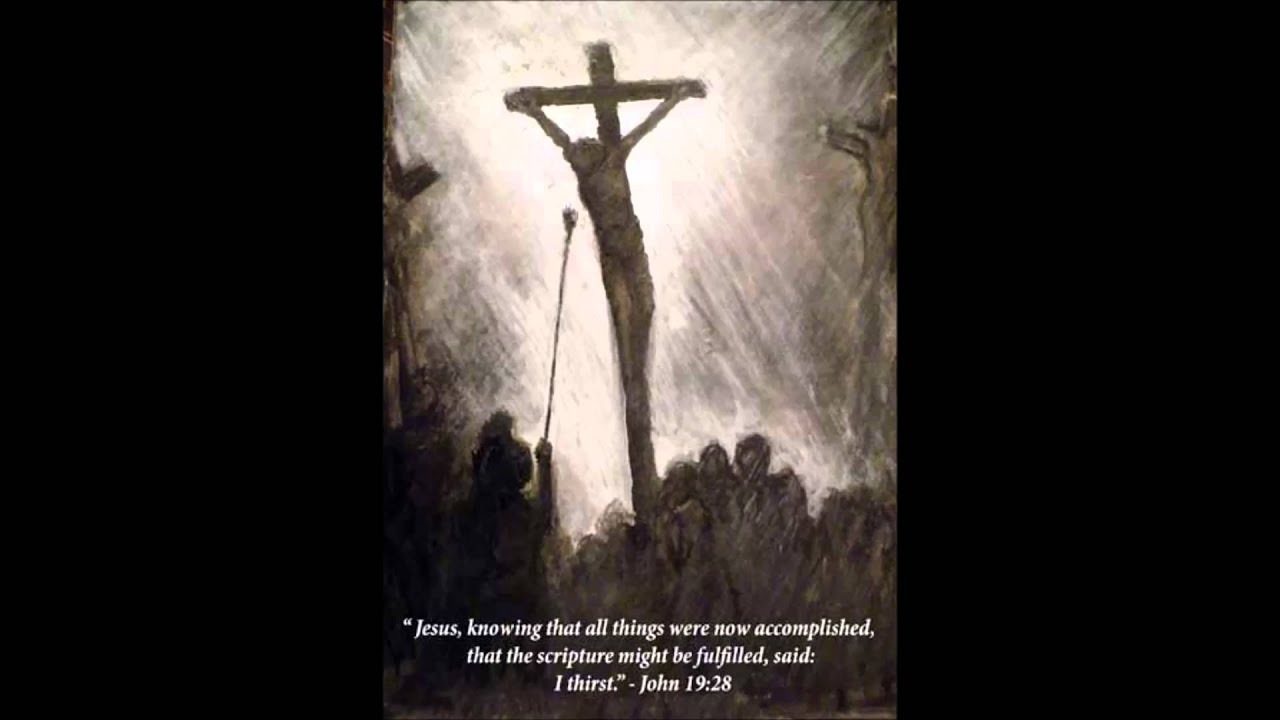
FIFTH WORD 5. After this Jesus, knowing that all was now finished, said (to fulfil the scripture), “I thirst.”
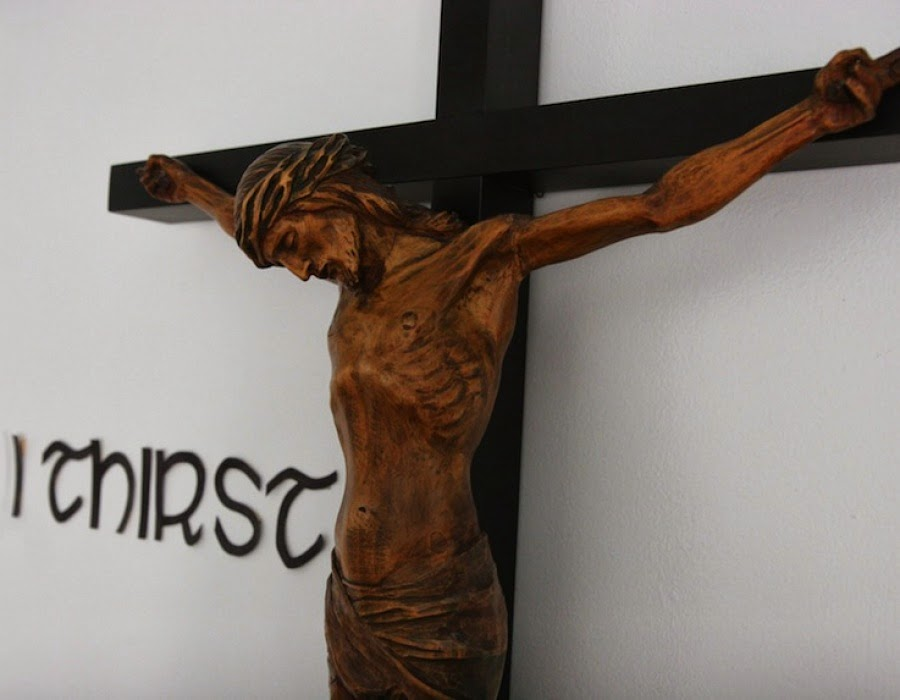
In all convents of Mother Teresa’s missionaries of Charity, there is a life-sized crucifix in the chapel next to the chapel with these two words painted on the wall under Jesus’ right arm. I thirst.
John tells us that the soldiers stick a long branch of hyssop into a jug of sour wine, or the word vinegar, and so we often interpret that as a bad joke from these rough men – the prisoner thirsts, let’s give him vinegar. Actually, this was basically the Roman soldiers’ Gatorade when serving in a hot climate like Jerusalem, and they put it up to His broken lips; or they put in a narcotic to ease the pain. They are most definitely aware of the drama and are being caught up in it more and more. Or it is an intervention by someone hoping to revive Jesus with this vinegary wine, to drag out Jesus’ life a bit longer so as to see if God was going to intervene for Him or if the Prophet Elijah was going to appear.
Even the most ignorant soldier on duty that day knew these things:
The priests have come out to a public execution site on the biggest Jewish holy day to watch this man suffer and die, and they have mocked him and cursed him;
there is a large crowd that is simply watching – no words from those people at all are recorded, but probably a steady stream of crying , a mix of sad sounds and curses on Christ.
darkness, wind, sand, the sun blocked out over the holy city;
no matter their religion they probably are frightened and worried – will they be caught in a massacre, is there going to be rioting, why this crowd that all the evangelists say just watches, why are the priests and elders coming out when even the Roman soldiers know that Jewish purity laws should be keeping them in the temple on Passover;
Prisoners on crosses screamed all the time, but not a scream in Aramaic to the Jewish God, quoting a prayer that suddenly got that big crowd moving around because the people were trying to interpret the words to one another. No matter how tough these soldiers are, they are all getting affected by this tragedy and the obvious religious elements that are present, as we know from the conversion of their leader which will happen when Jesus dies.
And so Jesus says I thirst, and they respond with the hyssop branch, they unconsciously recognized Jesus as the Paschal Lamb. Hyssop: a hyssop branch was used in Exodus to sprinkle the blood of the first Passover lambs on the doorways of the Israelites to shield them from the avenging angel of death, it was used in the temple by the priests for sprinkling of water, and it is symbolically used still today in Catholic parishes with the large aspergillum which the priest puts into holy water and blesses the people with at the beginning of Mass or in our rite for the blessings of people and items. You see, no detail is too small in the Passion narrative, or in any of the gospels. The soldiers didn’t use any kind of stick, or even a spear. They use a branch from the plant that is filled with such symbolism to assuage the thirst of this, the eternal Passover Lamb Who saves us from the death of sin and opens the doors of paradise to the thief, to the souls trapped in Sheol, and to the souls of those who believe in Him and do His will.
I thirst. He most certainly was thirsty. This is why the flow of the blood and water is seen as a miracle as we will hear next Friday night. He could not have had much water left inside him at this point. In psalm 22 that he had begun to quote, it says, “My throat is as dry as a pot shard and My tongue sticks to My jaws.” And he also says this word to fulfill Scripture: Ps 69:22 “and in my thirst they gave me vinegar to drink.”
He remains faithful to the will of the Father. Even what the prophets wrote about me are fulfilled as I fulfill my life to the Father. His anguished suffering is a mission, remember, a mission to save human souls and to restore the balance of broken creation. He came to fulfill the will of the Father, the Father whose will you and I promise to fulfill every single time we recite Jesus’ prayer, Our Father. He said in life to his followers walking those dusty desert roads in the hot sun, in the courtyard of the Temple in John 7:37-38 “If anyone thirst, let him come to me and drink. He who believes in me, as the scripture has said, “out of his heart shall flow rivers of living water”.
Saint Therese of Lisieux: “He has so much need of love and He is so thirsty, that He expects from us the drop of water that must refresh Him! Ah! Let us give without counting the cost.”
As long as you do not know in a very intimate way that Jesus is thirsty for you, it will be impossible for you to know who He wants to be for you, nor who He wants you to be for Him. St Therese was loved and is loved for her Little Way – the smallest things can be moments of absolute love for God. Consider though her words: He has so much need of love” – really! God needs my love! Why? Because He is Absolute Love, He is indeed thirsty, thirsting for love. God does not thirst for animal sacrifices; He tells the people in Isaiah 1 that He wants converted hearts, and that is the first reading for Lent in the Byzantine rite at the Sixth Hour. God needs our love –He who made me, wants me to love Him. Let us give to Him without counting the cost – oh let us do so!
Mother Teresa writes that we must end God’s thirst. She was asked when did you first feel Jesus’ thirst? She said, “My First Communion.” The Sister asked, “But as an experience?” And Mother Teresa answered, “It is reality – not just an experience that is felt, but reality.”He thirsts for souls – first our own individual and then those which we will lead to Him. He thirsts, and He ends all thirst. Water will come suddenly upon those who see Jesus naked, wounded, dried out, bloody, worn and ragged. Tonight, going to bed, tomorrow getting up, and every day thereafter, Jesus has a thirst that is for me, and for the world. It is in our ability, thru the waters of baptism, to bring souls to him and end his thirst. But we must feel it as Mother Teresa says, we must feel it as a reality that will drive us forward to Him and inward into His all-loving and all-forgiving Heart.
Let us give back to Him without counting the cost.
And when the sixth hour had come, there was darkness over the whole land until the ninth hour. And at the ninth hour Jesus cried with a loud voice, “Elo-i, elo-i, lama Sa-bach-tha-ni?” which means, “My God, my God, why hast thou forsaken me?”
Mark writes that there was darkness until the 9th hour, or 3 pm, which is marked by Jesus’ scream: not a crying out, but a scream. Matthew writes that from the 6th hour to 9th there was darkness, and then Jesus’ scream comes from the Cross. Luke says that around the 9th hour the sun eclipsed, casting the city into darkness.
An eclipse cannot happen at Passover because the earth is between the sun and moon then. The darkness is rather of God’s making and direct intervention. God is intervening dramatically on Calvary now and in the Temple. This eclipse, this darkness only over the holy city, provides physical evidence to show God as the ruler of time and nature.
Darkness was invoked by some of the prophets predicting the messiah, and the first Christians were very aware of this. Zephaniah 1:15: day of wrath, a day of darkness and gloom.
Joel 2:2: It is near, a day of darkness and gloom.
Joel 3:4 The sun will be turned to darkness, at the coming of the great and terrible day of the Lord.
Amos 8:9-10: the sun shall set at midday, and the light shall be darkened in the daytime. I will make them mourn as for an only son and bring their day to a bitter end.
There is nothing worse for human beings than darkness, for with it comes fear of the unknown and unseen. Earlier remember that the Jewish leaders wanted a sign: Come off the cross. They wanted a sign? Now God gives a sign and He gives it bluntly. Darkness for three long hours causing anxiety and fear on that Passover day of joy, an earthquake, rocks ripped apart, and this incredible heart-rending scream from the man on the central cross in Jerusalem which to the ancients was the center of the world, from the cross whose wood stabbed Death in its heart.
Jesus’ screams in the darkness surely rocked the crowd and the soldiers, because this is not an ordinary tortured cry from a prisoner. Rather, all are sensing God’s wrath is upon Jerusalem. Darkness was one of the plagues on Egypt. Those who reject the Messiah say in Wisdom 5:6 the sun did not rise upon us. Jesus raised himself up on those pierced feet twisted by that huge spike and screams – he cries out with all the force he can possibly muster from those tortured lungs and that dry, dry throat and broken mouth. Those who mocked him wanted a sign – Mark says now here is their sign.
If someone speaks more than one language, usually in times of stress that person will revert to the one he considers to be his mother tongue. Thus, Jesus does this great cry, this awesome “why?” in Aramaic, and the gospels preserved it as such when written in Greek or any other tongue, as we do today in all modern bibles. Jesus showed absolute obedience, begun in Gethsemane, in this prayer. In Mark and Matthew, Jesus who has lived in such union with God the Father, for the first time feels his absence – at the worst possible moment. He does not say Abba. He uses instead the words of a servant. It is ripped out of him. Jesus is still praying though – out of all the possible ways of expressing this desolation, he chooses Ps 22, verse 2.
Why not one of those verses? I think because He wants us to know by using the first incredibly sad verse, He will identify with every one of us who faces doubts in the years after Him – He knows what we feel, and He points to the solution. After the scream and those painfully pronounced words, I think that He cries in that awful darkness, but He has expressed both utter loneliness that unites Him to every human who will die after him, but also it is truly the fulfillment of that traditional teaching: He trusts that the Father will hear Him, will act, will somehow deliver Him.
When Jesus was rejected at Nazareth, he could have called on his angels to help – but he walked thru them (the crowd parted, like the waters of the Red Sea). When Jesus was in the garden, he could have fled from the cup – but he does not, because the mission must be fulfilled. At Pilate’s court he says he could call for twelve legions of angels, an incredible amount of heavenly messengers and divine forces, but he does not. And now … no one can share in this death. No one can understand what it is to suffer like this for the entire human race and in such horrible agony in muscles, nerves, and bleeding.
The mockers had said he said the temple would be destroyed and he would restore it in three days – well, the temple is ripped apart now by the hand of God. God responds VIGOROUSLY to Jesus’ scream – Jesus is not forgotten at all. And he is angry and sad. Elisha, when Elijah departed the earth, tore Elijah’s precious cloak into two pieces, and now God tears the sanctuary curtain into two pieces with His hand for Matthew says it is from the top down. The sanctuary is no longer veiled as a holy place – God has left. In Ezekiel 10 God left because the Jews allowed idolatrous acts to take place in the temple, and then God used the Babylonians to destroy the desecrated temple. In a Jewish apocryphal work written after the destruction of Jerusalem in the year 70, an angel tears the veil and a voice says “Enter enemies and come adversaries, for He who guarded the house has left it.”
In the gospels there is no voice, but the sudden and immediate action of God ripping the curtain from the top down gives voice to the feelings of God. Those who read Mark’s gospel at the time of the Roman siege and then destruction of the temple surely believed that this was indeed fulfillment of Jesus’ warnings because that earliest of all gospels is written before the disasters of the year 70. In Matthew, the rocks are ripped apart and the tombs of the holy ones open up. In Luke the ripping happens before Jesus dies, joined to the darkness that engulfs the city and a positive response to Jesus’ cry on the cross. In Luke the tearing of the veil is a warning to the Jewish leaders that they cannot continue to reject Jesus and his teaching as brought by the apostles and first converts who went into the temple daily to pray as we see in Luke’s 2nd book, Acts of the Apostles. But they fail to heed the warning, and as St Stephen is being killed in Acts, he tells the leaders that God has left the sanctuary. There is a period of grace to understand what they did and to repent, and indeed thousands converted, but the main religious and political leadership do not, and thus Jerusalem will be destroyed.
Either way, the tearing of the veil is a vindication of the suffering Jesus alone, naked, whipped by the wind, struggling in darkness to see those who loved him and who were his own, and who screamed in fear and pain and isolation. When someone says to me, no one understands my pain – I tell them they are foolish, for God most definitely does since he understood the pain of Jesus in the worst dying possible. But remember: Psalm 22 is a psalm of triumph, for while it predicts the Passion of Jesus in great detail, it also is a song of how the messiah will conquer his enemies, how God hears the cry of his servant, and how God vindicates his suffering, and by extension, how God vindicates all of our sufferings.
Standing close to Jesus’ cross were his mother; his mother’s sister; Mary the wife of Clopas, and Mary Magdalene. Jesus saw his mother and the disciple he loved standing there; so he said to his mother, “Woman, here is your son.” Then he said to the disciple, “Here is your mother.” And from that time the disciple took her to live in his home.
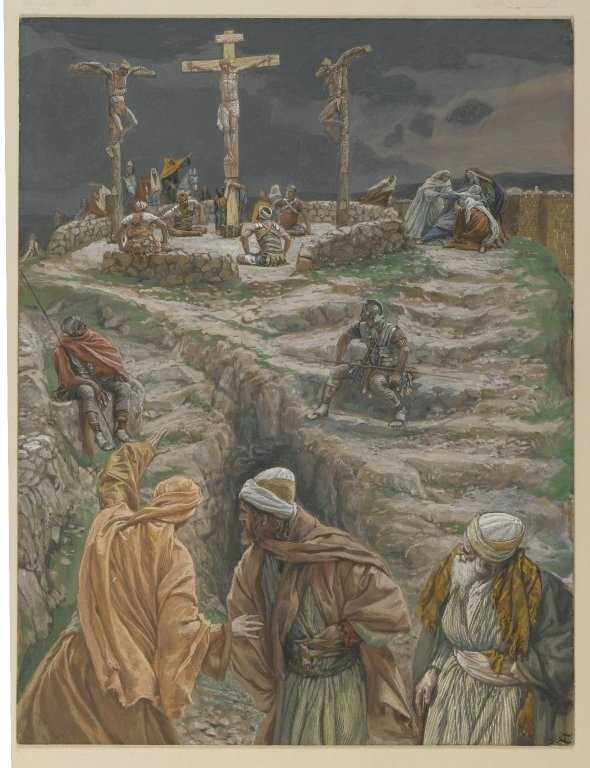
We have the soldiers at the foot of the Cross, the Jewish leadership passing back and forth mocking Jesus, and the “crowd” of people observing from a distance. Included in this is the large group of women, and of this group there is the smallest group of his disciples: Mary his Mother, assorted women who are relatives and disciples, and John – they are not near the cross as is shown in paintings – the soldiers would keep them away until death, so now He must push Himself up and shout from his dry throat to them. They are HIS OWN. We are HIS OWN as result of this Word.
There is a two-fold action in this word: 1. Mary is a widow without other children; Jesus is dying and so He makes a testament statement giving her to the care of John. Of all the apostles, John is the one. So, it is a buttress to the tradition that Mary had no other children, as obviously there is no one around to take her into their homes after the death of her Son
2. Why does this happen? St John’s gospel never names Mary and the Beloved Disciple – they are historical persons, but their importance is in their titles: Mother and Disciple. He is the youngest, a son of Zebedee along with James the Greater, a youngster of great emotion since Jesus called him and his brother “sons of thunder”, and the one who truly loves Jesus and whom Jesus can love. He is shown beardless always to emphasize his age – much younger than James the Greater and the last of the apostles to die, sometime around 90 AD. Galilean men were known to be devout, industrious, physically tough, brave, and valiant defenders of the Jewish nation. We see this when James and John want Jesus to call down lightning to destroy the Samaritan towns that reject the gospel, and when they want Jesus to punish a man using Jesus’ name to cast out devils: they most certainly are zealous for the Lord! Their mother Salome made the request to Jesus, in true motherly intercession, that they be allowed to sit at Jesus’ right and left in glory: to be his closest warriors and servants.
The other apostles were generally mature men in their 40s and had their own businesses. James and John are younger, and left their father Zebedee and his business: they are the prototypes of youth who ready to go into action for God as is shown in all four gospels. They are the ones who accompany Jesus at the most special moments along with Peter who is equally brave and emotional and strong. This James is called the greater which actually means the taller – James the Less who was the relative of the Lord and became first bishop of Jerusalem is the James who in his martyrdom forgave his killers just as Jesus did.
A common interpretation to this Word is that a Jewish widow with no children had few rights, and the Mother of the Lord is a widow whose son has been killed in the most horrible way known to mankind at that time, and he is a failed prophet. She needs to be taken into some man’s house. But Jesus, and St John in his Gospel, have far bigger concerns than that, and so does Mary: they are now the best examples of discipleship. Mary is the one who has pondered and meditated in her heart (St Luke), she is the one who knew that Jesus was ready to begin his signs of his public ministry at Cana, she is the faithful one who will be in the center of the company during the nine days of prayer waiting for the Holy Spirit (Acts).
Notice that the others were not jealous of John. Rather, they wished that they could love Jesus with that much single-minded devotion and could follow Jesus absolutely as John does. All who are young – develop now your love for Jesus, stoke it in a furnace of pure love and self-giving. All you who are young – keep the fervor you have now for God and maintain it all your lives. All of us who are older – set aside the stuff that clutters our minds and thoughts and prayers and retrieve the enthusiasm of this Galilean teenager, his love for God, his passion for what is right, his devotion to truth, so that others can say of us when we go home to God – truly he was God’s disciple.
In the Synoptic Gospels, Mary shows up unnamed during Jesus’ adult ministry, as his mother along with his “brothers” who either come to take him home or come to see him, but Jesus declares, in violation of all Jewish tradition, that his family consists of those who hear the word of God and act upon it or keep it in their hearts. “Whoever does the will of God is brother and sister to me” – that was a radical break from the Jewish family and Israelite family.
In Mark and Matthew, the disciples and the family are separated. In Luke’s gospel the mother and brothers take on the model of discipleship. This is what John does now with Our Lady and the Beloved Disciple. Now, the natural family (mother) comes into the realm of discipleship (John). She knew better than Jesus at Cana that it was time for him to start preaching, but now is the hour come – the hour in which Jesus embarks on a cataclysmic battle against the forces of darkness and sin in order to wrest the souls of all mankind from the broken world of sin and bring us into the healed world of redemption. And the disciple – if Mary is now his mother, then what is he to Jesus? Brother.
Let us ponder the awesomeness of this: the eternal God, maker of all things, calls us brother and sister thru our relationship to him in Mary. We say it casually but it is more than what it sounds like: a whole new family, united by His humanity, sustained by the Holy Spirit, at great cost to Jesus, and totally as a gift.
From that moment, he took her to his own –Mary is the New Eve, the mother of us who are his disciples. She now becomes mother of the church and the new Zion. She who is in mourning on Friday becomes the Mother of all.
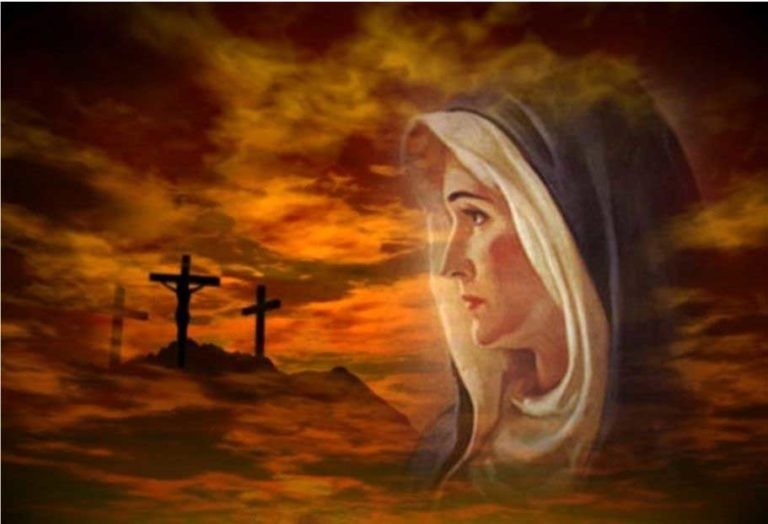
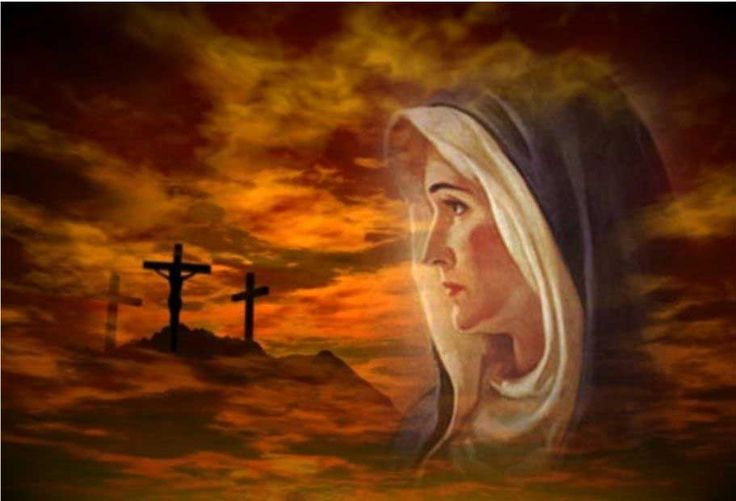
And here is an IMPORTANT NOTE: Mary grieves, but not without hope. In the Gospel, she STANDS at the Cross, and this is how she is always shown in icons. She gives strength to Jesus, she stands as legal witness of the sacrifice, she stands as an eternal sign to all Christians, she stands in absolute faith and fidelity at this, the most terrible hour of all the hours. She does not faint away, this widow, nor does the teen aged boy. They stand – so must we, for Christ, for His faith, for the Church, for the gift entrusted to us by our divine brother can never be snatched away by any force on earth.
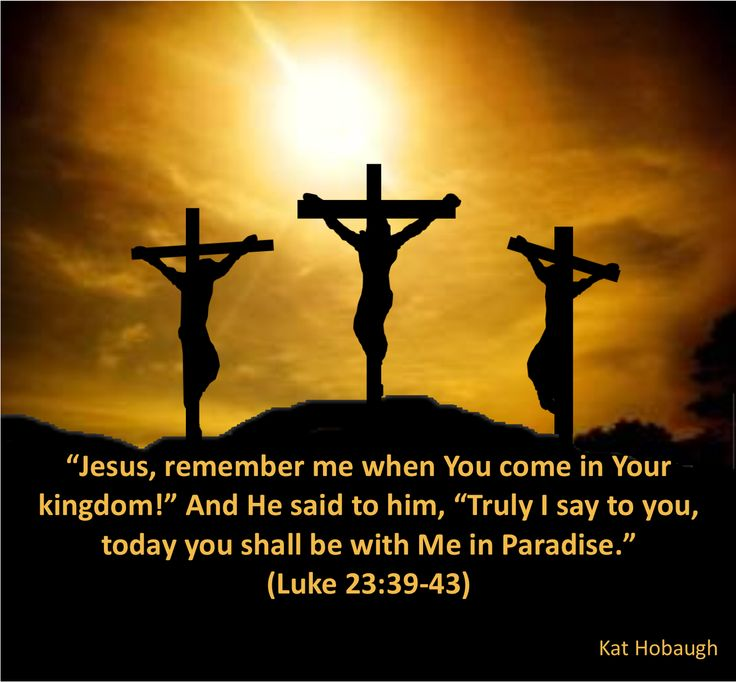
One of the criminals hanging there threw insults at him:"Aren't you the Messiah? Save yourself and us!" The otherone, however, rebuked him, saying: "Don't you fear God? Herewe are all under the same sentence. Ours, however, is only right, for we are getting what we deserve for what we did;but he has done no wrong." And he said to Jesus, "Rememberme, Jesus, when thou shalt come into thy kingdom." Jesus said to him, " Amen, Amen, I say to thee: this day, thou shalt be with me in Paradise.
The bible does not say that the two criminals crucified on either side of Jesus were thieves. Rather, they are bandits and wrongdoers – whatever they did, it was especially bad. That means that either they were large-scale robbers, like highwaymen who attacked caravans, or they were terrorists from the Zealot rebels who launched attacks against the Romans and supported various false Messiahs during the span of the first 150 years of the Christian era.
We forget in worshipping the Prince of peace that the region of modern Israel was about as peaceful then as it is now – there were sporadic and sometimes very well-organized assaults against the Romans, which would culminate in the prophecy of Jesus regarding the city of Jerusalem – its complete destruction and burial in the year 70, only 36 years after the death of our Lord. Jesus is mocked three times, but the mocking by the bandits is the shortest – they don’t have the air to spend on long sentences.
Jesus is truly alone – even they reject him. BUT Jesus will show great mercy to the wrongdoer, the lawbreaker. Mocked without mercy, Jesus now shows mercy. He saves the other bandit by staying on the cross and entrusting himself to the Father. Why? This one, the Good Thief as he is known, realizes who the Lord is, both in terms of his reputation and the reality of Jesus as the Son of God. First, he asks the other thief, “Have you no fear of God?” This is the first step to conversion. Then, he says this: “We have been justly condemned”– but Jesus is suffering wrongly. “He did nothing disorderly and is innocent.” He knows of Jesus, and like the wife of Pilate knows that he is a just man.
Thus far the thief has acknowledged the need to fear, respect, and honor God, and he has made a confession of his sins, recognizing his mistakes. When we acknowledge God’s power and sovereignty, and then acknowledge our own guilt we are experiencing a sincere change of heart.
Now what does this eloquent thief say? It is a shocking sentence – he says JESUS – the only man to address Jesus by name in ANY gospel – with no title – this is a sincere cry from his rapidly changing soul – remember me! He trusts that Jesus has the authority to help him and he anticipates the invitation Jesus normally gave to sinners to repent. Jesus answers with AMEN twice! A most definite pronouncement from the king of all and a solid promise. Luke does not have any AMEN sayings – only HERE! It is Divine graciousness beyond any human expectation! In Luke 11:9 Jesus said “Ask and it will be given” – the great merciful Jesus is going to indeed hear the prayer of this wretched sinner who asked to be remembered and Jesus says “thou shalt be w/ me this day” – the day which is going to close so quickly after the 9th hour, 3 pm, the day of absolute salvation. Jesus gives deliverance, Jesus gives intimacy. Jesus makes him a disciple, that precious role. And where will they be? In the presence of the absolute fullness of God. God exercises incredible graciousness thru the person of Jesus. How can Jesus grant such a thing to a sinner? But Jesus indeed came for that reason into the world, to save sinners, St Paul says, and this is echoed today in the Byzantine Rite before receiving Holy Communion – to save sinners, of whom I am the first.
Today thou shalt be with me in paradise – “today” in the Hebrew Scriptures stands for eternity. So Jesus promised eternal life to the thief. What is paradise, but the home of the Trinity, the angels, the Mother of God, all of the saints, all the people who have made it into the heavenly glory.
Why does the good thief convert? Roman historians said that those sentenced to crucifixion normally fought tooth and nail to avoid the cross, cursing the soldiers, struggling to escape their horrible fate. Jesus goes meekly, like a lamb to the slaughter, out of great love and so as to save the human race from being drawn into sin. Instead, Jesus ascends the cross willingly, as we sing in the troparion. Those dying on the crosses would curse the government and soldiers who put them there, but Jesus’ first word from the cross was one of forgiveness. This thief’s heart is transformed by Jesus’ last moments, not just to repentance, but to full awareness of exactly who Jesus is – the Son of God who offers eternal life to all. Ironically, being sentenced to die on Good Friday allows the good thief to be delivered from his sins and enter into heaven. Let us die to our own sins and go forward in trust to love the Lord and be with Him, fighting against sinful habits in this life and living in paradise after our deaths. Christ is among us.
The first of the Seven Last Words is spoken when the soldiers are gambling for J’s clothing. But “they” includes not only those men, but the leadership of the Romans and Jews who have put Jesus on the cross. At the station where the weeping women meet Jesus, he ministered to them, and remarking about his own suffering, he said “If in the green wood, they do such things” he means the leadership. And thus, he encompasses both the soldiers and the leaders in this first word. No matter how much plotting, no matter how evil they were, they really did not appreciate God’s great goodness or his plan of salvation, really they do not know what it is that they are actually doing. Jesus wanted this prayer to be imitated by his disciples – he does not give the forgiveness, but asks the Father to forgive them.
In the Nag Hammadi scrolls, there is an account of the killing of St. James, the first bishop of Jerusalem. James was the hero of the Jewish Christians, and there is a very strong tradition that he prayed for God’s mercy on his killer, in the spirit of Jesus His kinsman. And we find this in the bible among the Greek-speaking Christians: very quickly after Pentecost – when Stephen the deacon is being stoned to death, another horrible way to die, he prays for forgiveness of those doing the deed, after he sees the Son of Man, Jesus, at the right hand of God – in heaven, fully equal to God the Father.
Ever since Jesus’s utterance, and Stephen’s and James’ – all martyrs try to imitate Our Lord on the Cross and extend forgiveness to their persecutors. People still find it remarkable to hear someone grant forgiveness in situations of incredible violence and terror. I knew a survivor from the Communist era who heard her priest-father forgive those who turned them in to the KGB and the prisons of Stalin: if you don’t forgive, one said about the man who betrayed her father’s hiding place to the secret police, the hate will eat you up from inside, a spiritual cancer.
So here is a question for all of us in this Lenten season of conversion and repentance and healing: is there someone who I have not forgiven? Am I angry at someone – a person I know, a political or religious movement? Have I failed to forgive those who have damaged me? Society tells us too often that we should not forgive, we should not reconcile, we should hold onto our pain or anger. We know it is not physically or mentally healthy to do so – we know from the Lord Himself that we must ask God to forgive them. We also know from the Lord Himself that we must individually forgive.
After the resurrection, Jesus makes breakfast for the apostles while they are fishing. After they eat, he sits alone with Saint Peter. He asks Peter three times: do you love me? Three times Peter answers – it is the opportunity Christ gives to Peter to atone for denying Jesus three times during the Passion. If Jesus could forgive those who put him on the cross, if Jesus could forgive the close friend who denied and abandoned Him practically to His face, who am I to hold on to my anger, my hurt, my pain? Like that woman who had to forgive the neighbor who betrayed her father to the secret police, we know deep down that holding onto pain and anger is a physical and spiritual cancer eating away at us. It prevents us from loving God fully, from accepting His love, and from loving as He loves.
It is not easy to forgive someone who may not deserve it, who may not even want it, who continues to hurt others or even continues to hurt me. But if the martyrs could do it while they were suffering their own passions, so too can we. If I am holding onto something, this is the year to ask Christ our God that through His life-giving suffering and death, I be freed of it once and for all.
Today obviously is the Sunday of Icons, also known as Sunday of the true faith, or Sunday of Orthodoxy. It commemorates the final restoration of sacred images in the churches on the first Sunday of Lent in 843 in the Eastern Roman Empire. The procession recalls when the people, monks, and nuns carried icons that had been hidden during the persecutions and destruction of holy images into their parish churches to be used again in prayer. The heresy of iconoclasm, of breaking sacred images, was rooted in the denial of the incarnation, that God became Man, one of the central teachings in Islam. To this day you can go in old churches in Turkey or in territories that used to be ruled by the Turks in Europe and see how the Muslim warriors scratched out the faces on frescoes of the saints or shot up statues and icons.
We know that Nazareth was a small town, home to a completely Jewish population. Archaeology shows that the Jews of Nazareth in the first century kept to the strict orthodox rules regarding food and lifestyle. But as the Pharisees pointed out to Nicodemus in denying that Jesus was a prophet, there were absolutely no writings about anyone wonderful coming out of Galilee. The region was mixed with Jews and Greeks and other pagans, a bustling commercial area but with no religious significance at all. Nathaniel asks a logical question of Philip – how can anything good come from Nazareth?
Jesus answered, “Before Phillip called you, when you were under the fig tree, I saw you.” Sitting under a tree was not just something people did when they found shade in the heat of the day. Sitting under a fig tree was a particularly important thing to do when one was praying, or thinking deep thoughts. The fig tree was a symbol of God’s blessing and peace. It provided shade from the midday sun and a cool place to retreat and pray. The leaves are large, and an old fig tree can be quite large, protecting a substantial patch of ground and providing a protected space in which to pray or teach or just sit and think. Whatever it was that Nathaniel was pondering underneath that tree, it had to be something very important, because when Jesus says I saw you under the fig tree, he reacts with that powerful statement, Truly you are the son of God! He makes a gigantic leap of faith, not because he realizes not that Jesus could see him sitting under a particular tree, but rather that Jesus knew what was happening in his soul.
Christ sees us. In icons, the eyes are among the most prominent feature. Look up at the fresco on our ceiling – Jesus is looking down at us. In the window on the south side, he is looking out at us. In the icon of Christ the Teacher on the iconostas, he is looking straight out at us. Jesus sees us – God sees us. Think of the compassion in the eyes of Jesus; for these are the eyes through which God looks at us today. What compassion must have shown in His eyes when, looking at Jerusalem, He wept over it. What compassion must have shown in His eyes when He healed the sick and when He wept before the tomb of Lazarus, His friend.
People can look at someone else with hardness, gentleness, even indifference. Or we can look at someone and see beyond their body and notice something within them. This is the way God looks at us, and not just to see us, but to affect us. Jesus looked at the rich young man who was consumed with owning stuff, looked at him with love, but let him walk away when he wouldn’t get rid of the stuff. Jesus looked at the blind, the crippled, the sick, the lepers, the suffering and had compassion. Jesus looked and he truly saw into people, just like he does with Nathaniel. And Nathaniel also sees in a different way – he meets Jesus, and goes far beyond what Philip or Andrew or Simon could do – he is able to proclaim the truth of the Incarnation. “You are the Son of God.”
Icons can be made because of the Incarnation – Jesus was flesh and blood as well as divine, and therefore people truly met him, truly experienced him, truly encountered him. He was not a ghost, he was not some vague demigod, he was and is the Son of God as well as the Son of Mary. Christians have rooted all of their religious art in the reality of the incarnation, as is made clear in the teachings of the ecumenical councils that defined that mystery and that defended the making and veneration of icons. My experience has been that those who usually attack the use of sacred images tend to have a pretty limited vision of Jesus Himself. The Muslims deny the incarnation of God in Christ even while admitting the virginal conception of Jesus in the womb of Mary. The Jews believe that no one can depict the divine, and in that sense they’re right because no one can adequately paint God. But Christians should be able to depict the Lord, and therefore the Virgin and saints, because it is both an affirmation of the Incarnation and of the goodness of God’s created world and the elements inside it.
We are meant to not only pray with icons, but allow ourselves to use icons so as to see God, try to understand God better, let ourselves be opened to God’s mercy and grace. Philip proclaims to Nathaniel, “Come and see!” And Nathaniel does come, and does see, and sees far more than Philip had seen. This is our job as Christian people, as members of the true faith, as faithful participants in Catholic life, to come and see and to invite others to come and see. People think more about God during Lent, even those who are routinely indifferent to religious practice. The sudden prevalence of fish sandwiches at Blake’s and MacDonald’s as “spring specials” or “seasonal meals” make people wonder and then say, Oh yeah, it’s Lent. Take the opportunity to invite someone this year to worship with you. Use your icons at home to see God differently, to look at the large profound eyes of Jesus in an icon and see Him in a new way. Ask the Lord tonight and every day this week, help me to see you and recognize you more deeply this Lent. Make it a Lent that will be a Lent to remember, a Lent to be transformed during, a Lent to be made whole in.





 Father Christopher Zugger