Letter of Saint Paul to the Romans 5: For while we were still weak, at the right time Christ died for the ungodly. 7 Indeed, rarely will anyone die for a righteous person—though perhaps for a good person someone might actually dare to die. 8 But God proves his love for us in that while we still were sinners Christ died for us.
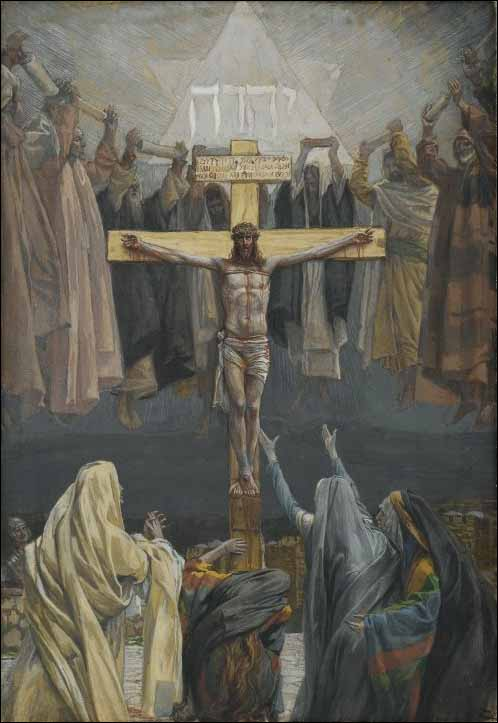
God proves his love for us in that while we still were sinners Christ died for us.
The Catholic Church is born on the Cross. Catholic means universal, and Pilate had the famous inscription “Jesus of Nazareth, King of the Jews” written in the three languages used in Judea and Galilee at the time: Hebrew, Latin, and Greek. There is no division in the Church, which serves all people. The Church is rooted in the sacrifice of Jesus Christ, born from the wounded side of Jesus, in the blood and water which gushed forth from his side when the centurion pierced his side and his heart. That blood is the blood of the Holy Eucharist, that water is the water of the Mystery of Baptism.
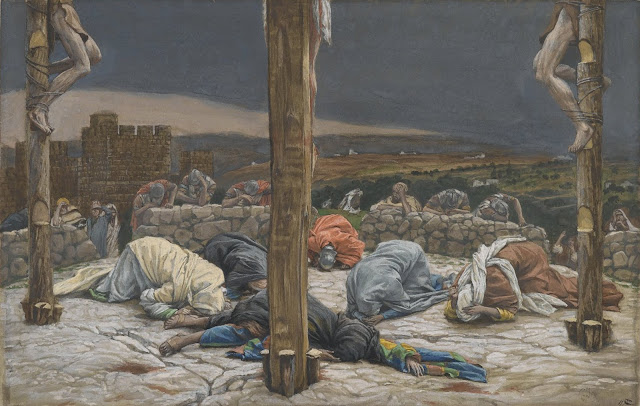
Our Blessed Lady and the teenager John, the Beloved Disciple, stand near the Cross. Mary becomes the Mother of the Church, John becomes the brother of Jesus, in that famous verse of the Last Words, “Behold your mother, behold your son.” The Church is rooted in these two and the holy women standing with them as being founded on their loyalty, their discipleship, their dedication to Jesus even at the worst moment possible. The Good Thief achieves salvation by acknowledging his guilt, by stating the innocence of Jesus from the false charges, and by proclaiming his confidence in the ability of the Lord to save his soul from perdition, and Jesus assures him, “today thou shalt be with me in paradise.” The sun had disappeared at noon, in fulfillment of the writings of the prophets Joel and Amos and Zechariah who predicted darkness and despair at midday, and the whole crowd of Jews and Romans was struck with fear and anxiety, but Jesus never condemned those who put him on the cross that day. Rather he said, “Father, forgive them.”
God proves his love for us in that while we still were sinners Christ died for us.
Jesus does not wait for the Sanhedrin to convert, or for the leaders to apologize to him. He grants forgiveness in a profound act of love and mercy. Christ does not cry out in despair when he says My God, my God, why hast thou forsaken Me? It is rather a cry of triumph, for Psalm 22 which he quoted is filled with predictions of Jesus’ passion, from the terrible dryness of his mouth to the soldiers gambling for his clothing. But that psalm ends with the triumph of the messiah, whose name will be known for generations to come, and here we are 2000 years later, gathered like that little band of disciples at the foot of his cross and proclaiming his passion and death.
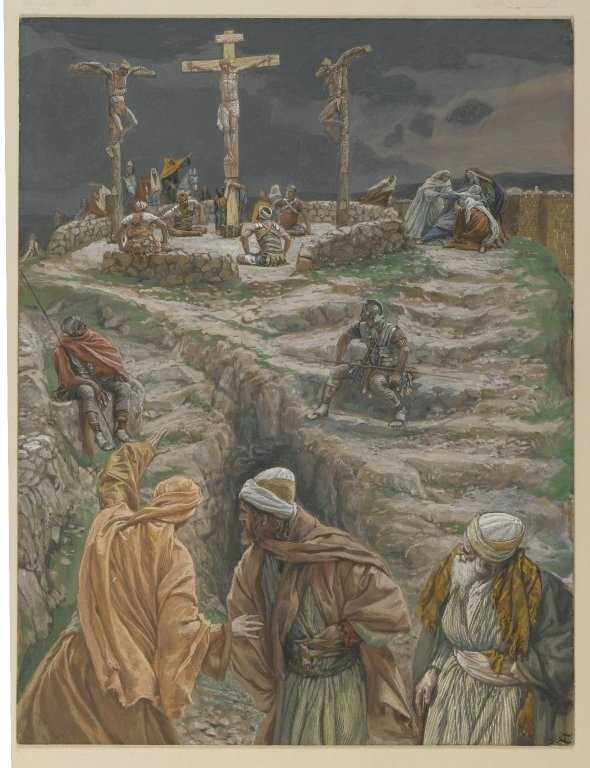
The Church is born out of Jesus’ suffering and death. The Church is based on the self-giving of Jesus – when He poured Himself out at the Last Supper in confecting the First Eucharist, that Eucharist we are privileged to make present at each liturgy; when he confronted the spiritual darkness of the world in the Garden of Gethsemane; when he endured false accusations in an illegal trial; when he was beaten and scourged and mocked by 200 angry Roman soldiers; when he carried his cross despite the tremendous loss of blood and being deprived of food or water through the hot streets of Jerusalem packed with pilgrims. He died on the cross as the true paschal lamb, the true redeemer of Israel, the true Son of God, and does so as the ultimate self-emptying act of divine love. Innocent, a miracle-worker, a preacher, who never hurt anyone, dies in great pain.
God proves his love for us in that while we still were sinners Christ died for us.
It is the great paradox of Christianity that we proclaim both a God who willingly ascends the cross for the most shameful and frightening form of execution known at that time, and that this God allows this to happen as an act of love. The Gospel tonight and the Twelve Gospels sung earlier today give us the entire passion of Jesus, from his walking to Gethsemane to his burial. Out of all of the thousands who had benefited from the miraculous feedings, the miracles of healing, who had heard his powerful words in his sermons, we know of only the Virgin Mary, Saint John, Mary’s sister, Mary Magdalene, Salome the mother of John, and Mary of Cleophas. Beyond them are the people of the crowd, those who watched the long painful drama. Who am I when it comes to living my faith, proclaiming our faith, defending our faith? Am I part of the band of faithful disciples, or am I watching on the sidelines? Do I start my day in prayer, or rushing around? Am I the person who curses in busy traffic, or the one who lets the other driver into my lane? Do I open my bible or a scripture app to read the scriptures of the day, or does the bible collect dust? Do I learn about the faith, about the holy trinity, about the saints, or am I ignorant beyond what I was taught for my First Communion?
God proves his love for us in that while we still were sinners Christ died for us.
Jesus came into the world out of love – He came from heaven and became incarnate of the Virgin Mary through the Holy Spirit so as to reopen the doors of heaven, closed when humanity turned its back on God’s command and committed original sin. He came to give us not an option, but the true path to living with him forever. Simon of Cyrene came to faith carrying Jesus’ cross, while the bloody Savior staggered from pain. The Good Thief came to faith hanging on a cross on Jesus’ right side, and is so drawn to Christ that he is the only person in the gospels who calls Jesus by His Name only. The women and the young teenaged lad stayed faithful in front of the tragedy when the men who had walked with Christ for three years had fled.
God proves his love for us in that while we still were sinners Christ died for us.
Golgotha was called the Place of the Skull. Not because it looked like a skull, but because it was said that Adam’s skull rested inside that hill outside of Jerusalem. The New Adam was crucified so as to redeem the Old Adam; on Holy Saturday, Saint Peter wrote, Jesus descended to preach to the souls of the righteous imprisoned in Sheol for thousands of years, and to deliver them into heaven and so to the true home of the human race. The Blood of the Lord trickled down the cross into the ground, announcing to Adam that redemption was finally at hand.
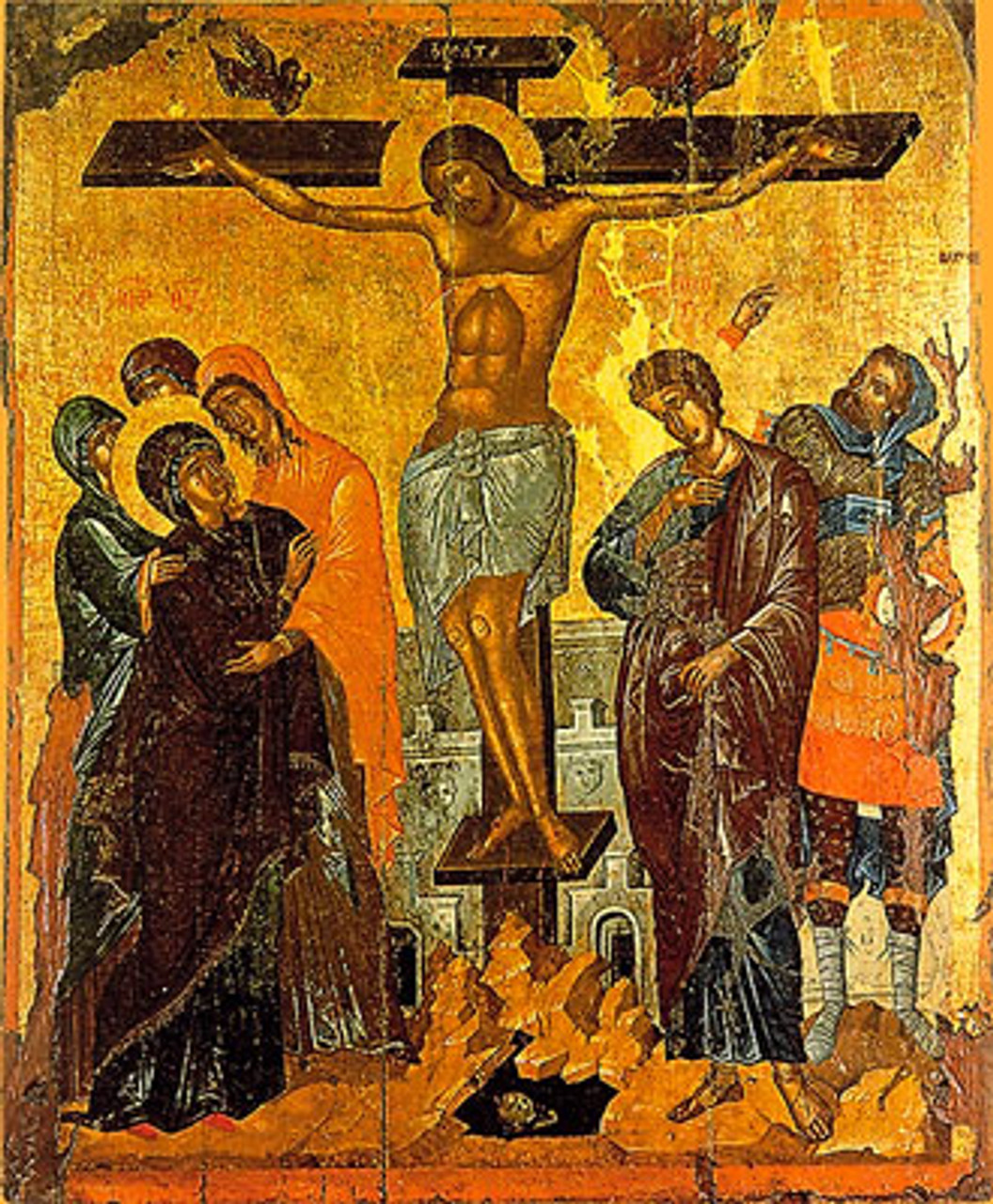
Our redemption is achieved on this cross. There is no salvation without the cross, there is no Easter Sunday without Good Friday. We are invited to accept this salvation, we are asked to realize fully what divine love is, how enormous it is, how generous it is, how gracious and merciful that love is on the cross. God proves his love for us in that while we still were sinners Christ died for us.
We are saved by the life, death, and resurrection of the Lord Jesus. The invitation is extended to us by the pierced hands of Jesus on the cross, by those arms stretched out to embrace the entire world. Do I accept this invitation? How am I living my faith out? Perhaps one-third of American Catholics attend Mass every month. Two-thirds of Mormons go every week, 44% of Protestants do, 38% of Muslims go to mosque weekly. But we, who believe correctly that the Crucified and Risen Lord gives us His Body and Blood, have two-thirds sitting at home routinely. The darkness that Jesus faced at Gethsemane, when his blood became like drops of blood falling down upon the ground, has engulfed our country. It is up to you, the laypeople who are so good about coming to church, you who faithfully worship so regularly, to bring souls into the embrace of those arms stretched out on the cross. It is up to you to learn your faith well so that you can truly invite souls to the Lord. It is up to you, above all, to believe that God proved his love for you, for us, for the entire human race, while we were still sinners, by the saving death of Jesus on the cross. God proves his love for us in that while we still were sinners Christ died for us.
So great is Christ’s love for us, that he would willingly endure the scourging, the beating, the mockery, the nailing to the rough wood of the cross, the piercing of his sacred heart, over and over again were it necessary so as to save each soul. But it is not necessary, for God has proven his great love for us in that one crucifixion, that one death, that one burial, that was done for us. People will take turns tonight to imitate Mary Magdalene and Mary of Clopas who stayed sitting in front of the tomb. When we kiss the wounds of Jesus on the holy shroud, when we sit in darkness, when we sit and pray, let us accept and own the fact that God loves each of us profoundly and deeply. Let us give thanks for this sacrifice. Let us resolve to be true missionaries of Jesus Christ in the world. Let us resolve to pray and do penance for the salvation of the world, the rebuilding of the Church, the conversion of sinners, and for the triumph of the Prince of Peace in the hearts of the world. God proves his love for us in that while we still were sinners Christ died for us. Let us live, pray, and witness to that accordingly.
 Father Christopher Zugger
Leave a comment