Rejoice greatly, O daughter Zion! Shout aloud, O daughter Jerusalem! Behold, your king comes to you; triumphant and victorious is he, humble and riding on a donkey, on a colt, the foal of a donkey. Zechariah chapter 9, verse 9
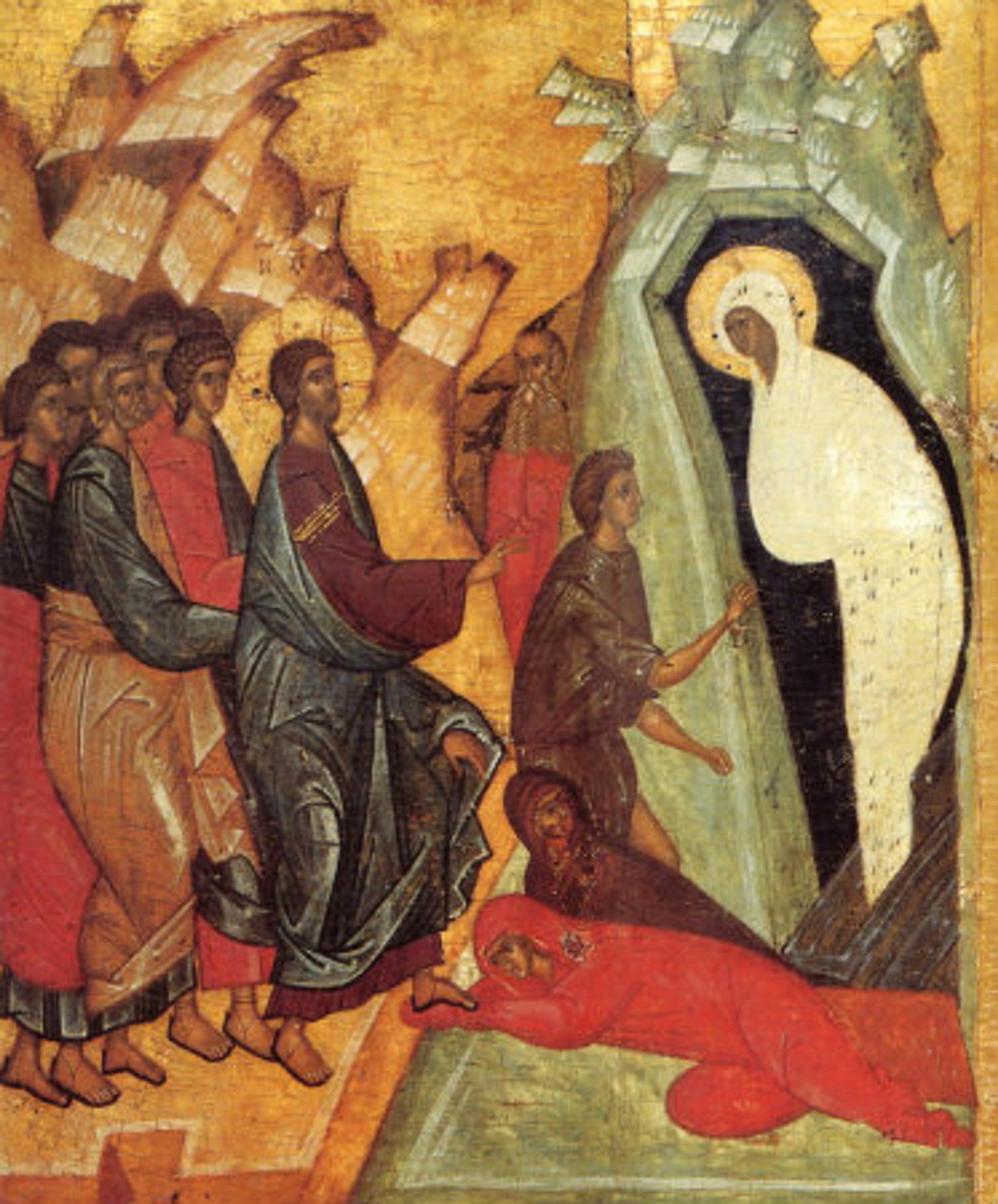
By the time Jesus enters the holy city, most people knew about the resurrection of Lazarus after four days in the grave. Not even the great prophet Elijah was able to achieve that. But even with that stupendous miracle, that challenged the teaching of the Sadducee party so much that they decide not to convert to faith in Jesus as the messiah, but rather to have him killed. That is what we are entering into this week. The Sadducees would rather hold to their preconceived notions that there is no afterlife, no resurrection of the dead, and only preservation of the Jewish nation as the reason for existence than believe that Jesus has come to bring about the fulfillment of the Kingdom of God. Caiaphas and Ananias were so corrupt, that they ignored the power of that miracle and all of the miracles, and instead worked at destroying him and the growing movement around him.
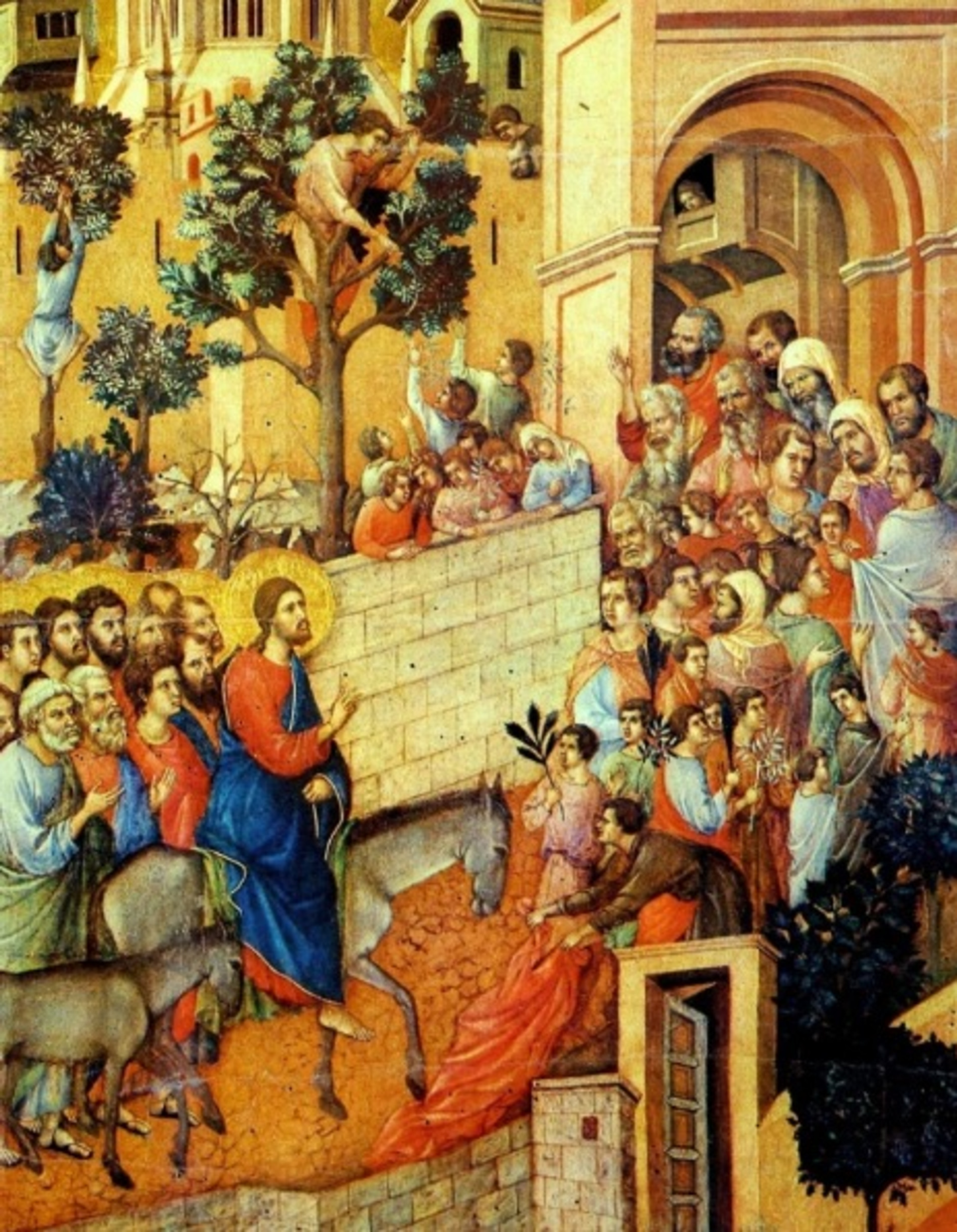
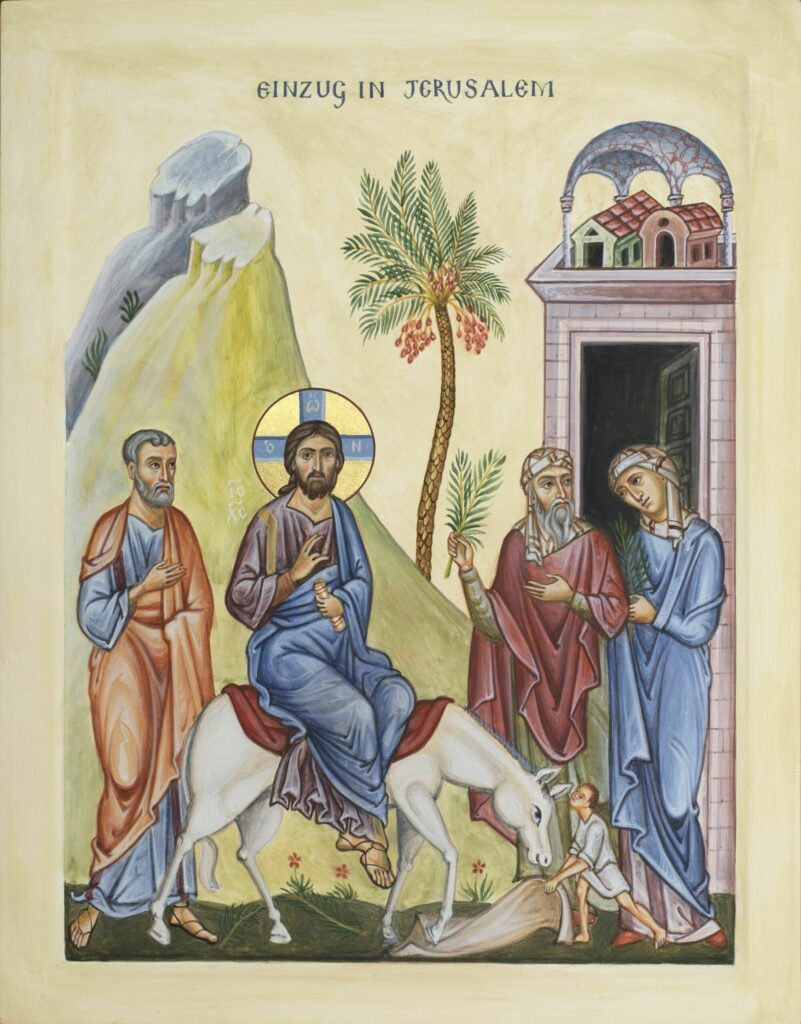
In ancient times, when a king rode into a city, it was usually with a show of power and wealth. Christ is both the rightful king of Israel and the gentle king. Jesus comes to greet his subjects, not with pomp and circumstance, but with all humility and meekness. At the very least, one would expect Jesus to ride a horse. But instead of coming on a mighty war horse, he rides a lowly beast of burden. He is riding a donkey, of all creatures—and a borrowed donkey, at that! He came in on a colt that has never been ridden by anyone. Try to get on any donkey or horse that has never been ridden before, and the animal will buck and toss off the person, because it is not used to the feeling of weight on its back. Instead, it is clear that our Lord simply gets on the animal and rides into the city, because like the ox and donkey in chapter 1 of Isaiah, that donkey recognizes its Master, its Creator, and simply goes along gently. Both the Lord and the donkey are gentle, and Jesus conquers with gentleness. The people acclaim him, the children praise him, and Jesus warns that even the stones of the hillside would cry out in triumph if the people had not done so.
Western societies of today worship celebrities and politicians and athletes. We want glitz, we want bling, we want to see someone set a new record. Just like people in the ancient world, we want to see glamour and we want to see power. Politicians who try to give reasonable answers to complicated questions are routinely ignored by our media in favor of those who give angry, often ignorant sound-bites. What would our media make of a gentle preacher, a teacher who refused to condemn sinners, a rabbi who broke the rules but did so out of compassion and love? Jesus created a family based on those who acted upon His word, a family based on discipleship. The prophet Zechariah used the word daughter, reminding the Jews that God saw the Chosen People primarily and first of all as His children, not as an aggressive power.
Christ gave care of the Blessed Virgin on Good Friday not to his aunt who was standing with her, but to the teenager John, who had no possessions of his own but the love he felt for the Lord. The family of Christ, the family of Christianity, the Church itself, is meant to be a community rooted in loving the gentle teacher who would not condemn sinners, but who did condemn injustice and cruelty. The family of the Church is supposed to be rooted in following the Lord Jesus Christ and proclaiming His Good News to a broken world that is racked by violence and anger and hatred.
We rightly condemn Vladimir Putin and his atrocities, and the Russian patriarch who has simply become the altar boy of the Russian dictator. But are we equally appalled at those around us who claim to worship Jesus’ Name, but condemn people for being the wrong ethnic group, the wrong religion, the wrong political party, sometimes even supporters of the wrong team, and use the Holy Name of Christ as a curse word?
This week this gentlest of kings, who children flocked to and an unridden colt accepted instantly, is going to endure abandonment, torture, great suffering and pain, and do so all because of his great love for each of us. He is most certainly not a weak man – he spent three years preaching and performing miracles despite pressure from the leadership in the Temple to stop. He interacted with foreigners as easily as he did with Jews. And in His passion, he went from the Last Supper all the way to the Cross, shedding tremendous amounts of blood and suffering at the hands of violent men, with neither food nor drink to strengthen him. His kingdom is one of peace, and sometimes it takes more courage to proclaim peace than to declare war. The prophet Zechariah says in verse 10 that the Messiah “will proclaim peace to the nations. His rule will extend from sea to sea and from the River to the ends of the earth” and proclaim the good news to the Gentiles. Jesus in His great power, in His great love, in His great gentleness, brings truth and the victory of peace to all nations. He is powerful enough to save the entire human race, and loving enough to intervene on behalf of every single individual, to year for the redemption of all of His creation.
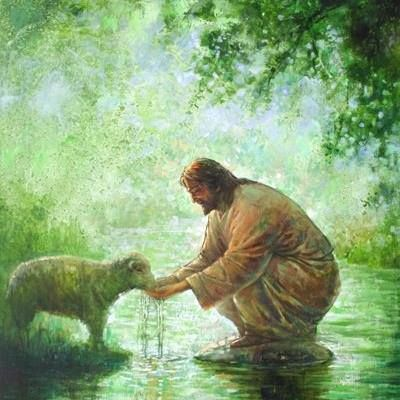
If we are saved by such a gentle king, then we should serve him with all gentleness. Gentleness is one of the marks of the Christian, the fruit of God’s Holy Spirit. Holy Week leads us to Easter Sunday, and Easter Sunday opens the door to prepare ourselves for the Descent of the Holy Spirit on Pentecost. We as Christian people, men and women and children, people of all ages, are called to transform a world that is currently dominated by violence, anger, nasty conversations, terrible wars into the world desired by God Himself.
Saint Paul proclaimed in his letter to the Philippians: “Let your gentleness be evident to all” (4:5). Jesus commanded at the Last Supper on Holy Thursday night, Love one another as I have loved you. The Blessed Virgin implored us at Fatima to pray for the conversion of Russia, not its destruction, and for the conversion of sinners, not their damnation. In waving palms and willow branches, let us be more faithful than the apostles were on Holy Thursday, more enthusiastic for Jesus than the crowd was on Good Friday, and more determined than ever to welcome the Resurrection on Pascha with converted hearts.
 Father Christopher Zugger
Leave a comment