
And when the sixth hour had come, there was darkness over the whole land until the ninth hour. And at the ninth hour Jesus cried with a loud voice, “Elo-i, elo-i, lama Sa-bach-tha-ni?” which means, “My God, my God, why hast thou forsaken me?”
Mark writes that there was darkness until the 9th hour, or 3 pm, which is marked by Jesus’ scream: not a crying out, but a scream. Matthew writes that from the 6th hour to 9th there was darkness, and then Jesus’ scream comes from the Cross. Luke says that around the 9th hour the sun eclipsed, casting the city into darkness.
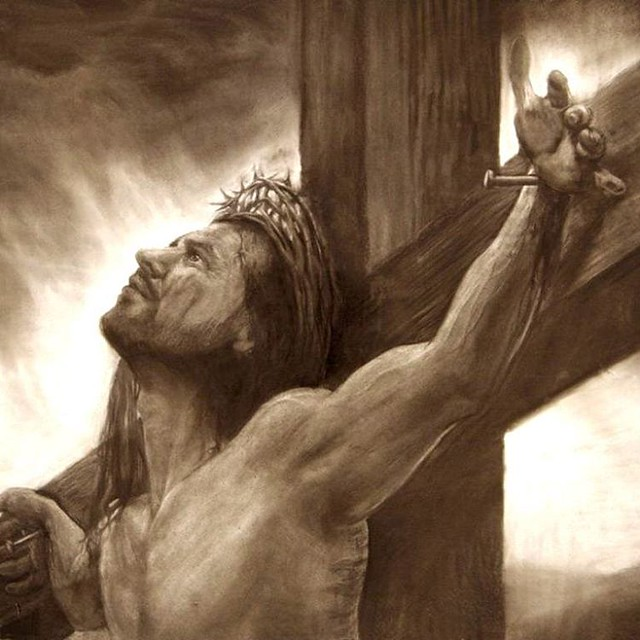
An eclipse cannot happen at Passover because the earth is between the sun and moon then. The darkness is rather of God’s making and direct intervention. God is intervening dramatically on Calvary now and in the Temple. This eclipse, this darkness only over the holy city, provides physical evidence to show God as the ruler of time and nature.
Darkness was invoked by some of the prophets predicting the messiah, and the first Christians were very aware of this. Zephaniah 1:15: day of wrath, a day of darkness and gloom.
Joel 2:2: It is near, a day of darkness and gloom.
Joel 3:4 The sun will be turned to darkness, at the coming of the great and terrible day of the Lord.
Amos 8:9-10: the sun shall set at midday, and the light shall be darkened in the daytime. I will make them mourn as for an only son and bring their day to a bitter end.
There is nothing worse for human beings than darkness, for with it comes fear of the unknown and unseen. Earlier remember that the Jewish leaders wanted a sign: Come off the cross. They wanted a sign? Now God gives a sign and He gives it bluntly. Darkness for three long hours causing anxiety and fear on that Passover day of joy, an earthquake, rocks ripped apart, and this incredible heart-rending scream from the man on the central cross in Jerusalem which to the ancients was the center of the world, from the cross whose wood stabbed Death in its heart.
Jesus’ screams in the darkness surely rocked the crowd and the soldiers, because this is not an ordinary tortured cry from a prisoner. Rather, all are sensing God’s wrath is upon Jerusalem. Darkness was one of the plagues on Egypt. Those who reject the Messiah say in Wisdom 5:6 the sun did not rise upon us. Jesus raised himself up on those pierced feet twisted by that huge spike and screams – he cries out with all the force he can possibly muster from those tortured lungs and that dry, dry throat and broken mouth. Those who mocked him wanted a sign – Mark says now here is their sign.
If someone speaks more than one language, usually in times of stress that person will revert to the one he considers to be his mother tongue. Thus, Jesus does this great cry, this awesome “why?” in Aramaic, and the gospels preserved it as such when written in Greek or any other tongue, as we do today in all modern bibles. Jesus showed absolute obedience, begun in Gethsemane, in this prayer. In Mark and Matthew, Jesus who has lived in such union with God the Father, for the first time feels his absence – at the worst possible moment. He does not say Abba. He uses instead the words of a servant. It is ripped out of him. Jesus is still praying though – out of all the possible ways of expressing this desolation, he chooses Ps 22, verse 2.
Why not one of those verses? I think because He wants us to know by using the first incredibly sad verse, He will identify with every one of us who faces doubts in the years after Him – He knows what we feel, and He points to the solution. After the scream and those painfully pronounced words, I think that He cries in that awful darkness, but He has expressed both utter loneliness that unites Him to every human who will die after him, but also it is truly the fulfillment of that traditional teaching: He trusts that the Father will hear Him, will act, will somehow deliver Him.
When Jesus was rejected at Nazareth, he could have called on his angels to help – but he walked thru them (the crowd parted, like the waters of the Red Sea). When Jesus was in the garden, he could have fled from the cup – but he does not, because the mission must be fulfilled. At Pilate’s court he says he could call for twelve legions of angels, an incredible amount of heavenly messengers and divine forces, but he does not. And now … no one can share in this death. No one can understand what it is to suffer like this for the entire human race and in such horrible agony in muscles, nerves, and bleeding.
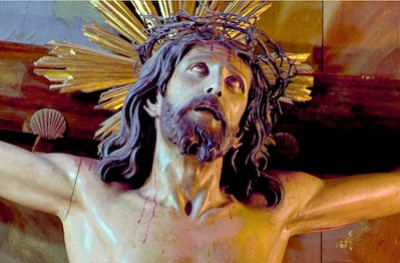
The mockers had said he said the temple would be destroyed and he would restore it in three days – well, the temple is ripped apart now by the hand of God. God responds VIGOROUSLY to Jesus’ scream – Jesus is not forgotten at all. And he is angry and sad. Elisha, when Elijah departed the earth, tore Elijah’s precious cloak into two pieces, and now God tears the sanctuary curtain into two pieces with His hand for Matthew says it is from the top down. The sanctuary is no longer veiled as a holy place – God has left. In Ezekiel 10 God left because the Jews allowed idolatrous acts to take place in the temple, and then God used the Babylonians to destroy the desecrated temple. In a Jewish apocryphal work written after the destruction of Jerusalem in the year 70, an angel tears the veil and a voice says “Enter enemies and come adversaries, for He who guarded the house has left it.”
In the gospels there is no voice, but the sudden and immediate action of God ripping the curtain from the top down gives voice to the feelings of God. Those who read Mark’s gospel at the time of the Roman siege and then destruction of the temple surely believed that this was indeed fulfillment of Jesus’ warnings because that earliest of all gospels is written before the disasters of the year 70. In Matthew, the rocks are ripped apart and the tombs of the holy ones open up. In Luke the ripping happens before Jesus dies, joined to the darkness that engulfs the city and a positive response to Jesus’ cry on the cross. In Luke the tearing of the veil is a warning to the Jewish leaders that they cannot continue to reject Jesus and his teaching as brought by the apostles and first converts who went into the temple daily to pray as we see in Luke’s 2nd book, Acts of the Apostles. But they fail to heed the warning, and as St Stephen is being killed in Acts, he tells the leaders that God has left the sanctuary. There is a period of grace to understand what they did and to repent, and indeed thousands converted, but the main religious and political leadership do not, and thus Jerusalem will be destroyed.
Either way, the tearing of the veil is a vindication of the suffering Jesus alone, naked, whipped by the wind, struggling in darkness to see those who loved him and who were his own, and who screamed in fear and pain and isolation. When someone says to me, no one understands my pain – I tell them they are foolish, for God most definitely does since he understood the pain of Jesus in the worst dying possible. But remember: Psalm 22 is a psalm of triumph, for while it predicts the Passion of Jesus in great detail, it also is a song of how the messiah will conquer his enemies, how God hears the cry of his servant, and how God vindicates his suffering, and by extension, how God vindicates all of our sufferings.
 Father Christopher Zugger
Leave a comment